



Desiccant vs. Hot Air vs. Compressed Air Drying: Selecting the Right Plastic Resin Dryer for Your Process

Ask any process engineer who has been on the floor long enough what defect causes the most headaches and moisture will be near the top of the list. Silver streaks, splay, bubbles, brittleness — all traceable to the same thing: water that should have been removed before the resin ever hit the barrel. The question is not whether you need to dry your material. The question is which drying technology makes sense for your specific resins, throughput, and operating budget. Three main contenders dominate the market — hot air dryers, desiccant dryers, and compressed air dryers — and picking the wrong one costs you in part quality, energy bills, or both.
Why Moisture Matters: It Is Not Just Surface Water
Before comparing dryer types, it helps to understand what we are actually fighting. Moisture in plastic pellets exists in two forms. Surface moisture is water clinging to the outside of the pellet — condensation from temperature swings, poor storage, or bagged material opened in humid conditions. This is relatively easy to remove.
Internal moisture is the real problem. Hygroscopic resins — PET, PC, nylon (PA6, PA66), PBT, TPU, PPS, ABS to a lesser extent — absorb water into the polymer matrix at the molecular level. Nylon 6, for example, can pull 1.5% to 3% of its weight in moisture from ambient air in a matter of hours. When this water hits melt temperatures of 250°C to 320°C in the barrel, it flashes to steam and hydrolyzes the polymer chains. The result: weaker parts, cosmetic defects, and material that will never recover its original mechanical properties no matter how much you dry it afterward.
Hot Air Dryers: The Budget Option (With Limits)
A hot air dryer is the simplest design in the book. Ambient air passes over a heating element, reaches a set temperature (typically 80°C to 160°C), and blows through a hopper filled with resin. The warm air heats the pellets and carries away surface moisture. That is it — no desiccant, no dehumidification, no closed loop.
Where Hot Air Works
Hot air drying is adequate for non-hygroscopic resins — PE, PP, PS, PVC — where the goal is to remove surface condensation, not internal moisture. It also works for pre-heating material before processing, which can reduce screw wear and improve melt homogeneity even when drying is not the primary objective.
Where Hot Air Fails
The fundamental limitation of hot air drying is that it cannot achieve a dew point lower than the ambient air. On a humid summer day in Guangzhou or Ho Chi Minh City with 80% relative humidity and a 28°C ambient dew point, your “dry” air is still carrying roughly 24 grams of water per kilogram of air. Blowing that through hygroscopic resin does little more than heat the pellets — the moisture gradient between pellet interior and surrounding air is simply not steep enough to drive internal moisture out. For PET, PC, or nylon, hot air dryers produce material with residual moisture far above the processing threshold, and the resulting parts will show it.
Desiccant Dryers: The Industry Standard for Hygroscopic Resins
Desiccant dryers solve the dew point problem by passing process air through a bed of molecular sieve desiccant — typically synthetic zeolite or silica gel — that strips water vapor down to a dew point of -40°C or lower. The resulting air is extraordinarily dry, typically carrying less than 0.1 grams of water per kilogram. This creates a massive moisture gradient between the pellet interior and the surrounding air, pulling internal water out through diffusion.
Twin-Tower vs. Rotor Designs
Traditional desiccant dryers use two desiccant beds in a twin-tower configuration: one tower dries the process air while the other regenerates by heating and purging the accumulated moisture. The towers swap roles on a timed cycle, typically every 3 to 5 hours. Twin-tower systems are proven, reliable, and available in sizes from small beside-the-press units (30 to 50 kg/h) to large central dryers handling 1,500 kg/h or more.
Rotor-type (honeycomb) desiccant dryers use a continuously rotating wheel impregnated with desiccant. One sector of the wheel dries process air, another sector undergoes regeneration, and a small purge sector cools before re-entering the drying zone. The continuous operation eliminates the dew point spike that occurs when twin towers switch over, providing more stable outlet moisture. Rotor dryers have gained significant market share in the last decade, particularly in PET preform and sheet applications where moisture consistency directly correlates with IV (intrinsic viscosity) retention.
Drying Parameters: Temperature + Time + Dew Point
Effective desiccant drying depends on three variables working together:
- Temperature: High enough to mobilize moisture molecules but below the point where the polymer thermally degrades. PET typically dries at 160°C to 180°C for 4 to 6 hours. PC dries at 120°C for 2 to 4 hours. Nylon dries at 80°C — push it higher and you risk oxidation and yellowing.
- Time: Sufficient residence time in the drying hopper for moisture to diffuse from the pellet center to the surface. This is a function of pellet size and polymer diffusivity — larger pellets and higher-crystallinity grades need more time.
- Dew point: The lower, the better. -40°C is the practical standard. At -20°C dew point, PET drying time roughly doubles compared to -40°C because the moisture gradient is shallower.
Running a desiccant dryer at the right temperature for too short a time produces the same bad parts as running it too cold — the pellets look and feel dry but have a wet core that flashes to steam in the barrel.
Compressed Air Dryers: Niche but Valuable
Compressed air dryers use plant compressed air expanded through a membrane or pressure swing adsorption (PSA) module to produce very dry air at low volume. The air is then heated and passed through a small drying hopper, typically serving a single machine.
The advantage is simplicity: no desiccant beds to regenerate, no blower, no complex controls. The compressed air system provides both the air supply and the drying energy. These units work well for low-throughput applications — a single injection molding machine running 5 to 15 kg/h of engineering resin — where the capital cost and footprint of a desiccant dryer cannot be justified.
The disadvantage is operating cost. Compressed air is expensive — roughly 7 to 10 kW of electrical input per 1 kW of compressed air output at the point of use, once you account for compressor inefficiency, leaks, and pressure drop through the distribution system. For a machine consuming 10 kg/h of PC, a compressed air dryer might draw 2 to 3 kW of equivalent compressor power, while a small desiccant dryer would draw 0.8 to 1.5 kW including regeneration. Multiply that across a 20-machine floor running 24/6, and the energy cost difference becomes substantial.
Selection Matrix: Matching Dryer to Material and Application
| Material | Moisture Sensitivity | Recommended Dryer | Typical Drying Temp | Target Moisture |
|———-|———————|——————-|———————|—————–|
| PE, PP | Non-hygroscopic | Hot air (or none) | 70–90°C | <0.1% |
| PS | Slightly hygroscopic | Hot air | 70–80°C | <0.05% |
| ABS | Moderately hygroscopic | Desiccant | 80–90°C | <0.05% |
| PA6, PA66 | Highly hygroscopic | Desiccant | 75–85°C | <0.03% |
| PC | Highly hygroscopic | Desiccant | 120°C | <0.02% |
| PET | Highly hygroscopic | Desiccant (rotor preferred) | 160–180°C | <0.003% (30 ppm) |
| PBT | Highly hygroscopic | Desiccant | 120–140°C | <0.03% |
| TPU | Highly hygroscopic | Desiccant | 80–100°C | <0.02% |
| PPS | Highly hygroscopic | Desiccant | 130–150°C | <0.02% |
| POM | Moderately hygroscopic | Desiccant | 80–90°C | <0.05% |
A note on ABS: while technically hygroscopic, many molders get away with hot air drying for non-cosmetic, non-critical ABS parts. The moment surface appearance matters — automotive interior trim, appliance housings — switch to desiccant drying. The cost of a single rejected batch from silver streaking covers the dryer price difference many times over.
Central vs. Machine-Side Drying: The Same Logic Applies
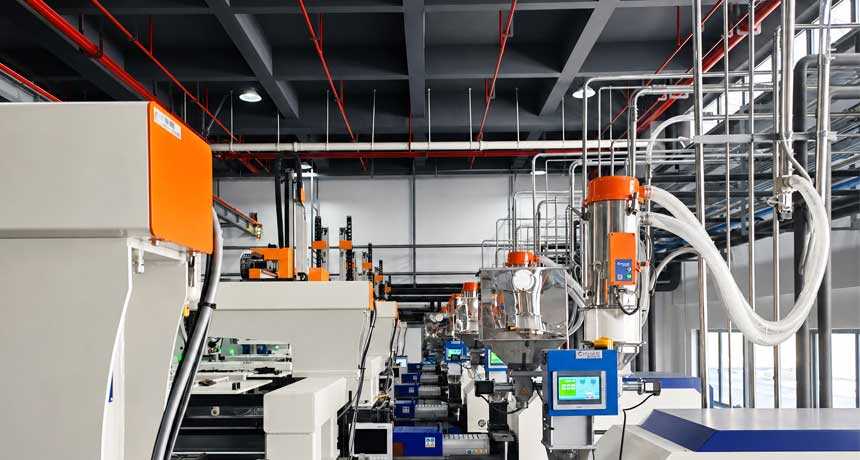
The central vs. machine-side decision for dryers mirrors the same calculation as conveying systems. Central drying makes sense when multiple machines run the same material at similar throughput — one large desiccant dryer feeding a manifold that distributes dried resin to 5 to 20 machines. The energy efficiency is excellent, and maintenance is consolidated.
Machine-side drying wins when materials, temperatures, and throughputs vary widely across the floor. Drying PET at 170°C beside a machine running nylon at 80°C from a central system is impractical — the two materials need fundamentally different drying conditions. For job shops and custom molders running diverse resin portfolios, individual machine-side dryers provide the flexibility that a central system cannot match without excessive complexity.
Energy Consumption: Where the Real Money Goes
Desiccant dryers consume energy in three places: the process heater (raising air to drying temperature), the regeneration heater (driving moisture off the saturated desiccant), and the blower (moving air through the system). Of these, regeneration typically accounts for 30% to 40% of total energy consumption in older fixed-cycle twin-tower designs.
Modern desiccant dryers reduce regeneration energy through dew-point-controlled regeneration. Instead of regenerating on a fixed timer, the system monitors the outlet dew point and only triggers regeneration when the desiccant is approaching saturation. In practice, this can cut regeneration energy by 40% to 60% because the desiccant bed rarely needs the full regeneration cycle that a timer-based system blindly runs.
Another energy-saving feature worth specifying is process air temperature control with PID loop. Older dryers use simple on-off thermostats that overshoot and undershoot the setpoint, wasting energy and thermally cycling the resin. A well-tuned PID controller holds temperature within ±1°C of setpoint, delivering consistent drying with minimal energy waste.
Maintenance That Actually Matters
Desiccant dryers need more maintenance than hot air units, and neglecting it shows up fast in part quality:
- Desiccant bed replacement: Molecular sieve desiccant degrades over time. Contamination from plastic fines, oil vapor from the regeneration air intake, and thermal cycling gradually reduce adsorption capacity. Most manufacturers recommend replacement every 2 to 3 years for continuous-operation systems. A desiccant bed operating at 60% of original capacity still produces “dry” air on the dew point meter — until the humidity in the plant spikes and suddenly it cannot keep up.
- Aftercooler cleaning: The aftercooler condenses moisture from the return air before it reaches the desiccant bed. Finned-tube aftercoolers clog with dust and fines over time, reducing heat exchange efficiency and raising the moisture load on the desiccant. Clean them quarterly.
- Filter changes: Process air filters and regeneration air filters prevent dust and fines from fouling the desiccant and the heater elements. Clogged filters reduce airflow, which reduces drying capacity. A 30% drop in airflow through a partially blocked filter translates to roughly 30% less drying — and the operator sees no alarm, just a gradual increase in reject parts.
- Hopper level management: A drying hopper should maintain consistent material level — not too full, not too empty. An overfilled hopper shortens residence time and sends wet material to the machine. An underfilled hopper over-dries the material, wastes energy, and risks thermal degradation of heat-sensitive resins.
Making the Right Call
Start with your materials. If you only process PE and PP, a hot air dryer does the job and costs almost nothing to run. If you run engineering resins — especially PET, PC, or nylon — budget for a desiccant dryer and do not cheap out on dew point control. Compressed air dryers fill the gap for low-throughput specialty applications where floor space and capital cost are the binding constraints.
The dryer is not something you install and forget about. Monitor dew point. Check the desiccant bed condition during scheduled shutdowns. Clean the filters. Measure residual moisture on dried resin periodically with a moisture analyzer — not just when parts start rejecting, but as a preventive check. The molders who do this consistently are the ones who do not get that 3 AM call about a shipment of silver-streaked parts heading to the customer.