




Why Drying Temperature and Time Matter in Plastic Processing

In thermoplastic processing, drying is one of the most critical yet often underestimated steps.
Whether processing amorphous plastics or semi-crystalline engineering resins, moisture must be reduced below the recommended moisture content before molding. Otherwise, defects such as silver streaks, bubbles, poor surface finish, dimensional instability, and reduced mechanical strength are inevitable.
However, successful drying is not simply about heating the material.
The real challenge lies in finding the optimal balance between drying temperature and drying time.
This balance directly determines production quality, energy consumption, and manufacturing efficiency.
Understanding the Temperature-Time Relationship
Resin drying is a complex process involving both heat transfer and moisture diffusion.
Its fundamental principles can be summarized as follows.
Temperature Provides the Driving Force
Higher drying temperatures accelerate:
- Moisture diffusion inside the resin pellets
- Surface evaporation
- Overall drying speed
Increasing temperature is the fastest way to shorten drying cycles.
Time Ensures Complete Drying
Even with sufficient heat, drying still requires adequate time for:
- Heat to penetrate into the center of each pellet
- Internal moisture to migrate toward the surface
- Moisture to evaporate completely
Without enough time, moisture remains trapped inside the material.
The Engineering Trade-Off
The relationship between temperature and time is always a balance.
High Temperature + Short Time
Advantages
- Faster production
- Higher dryer utilization
- Lower energy consumption per batch
Potential Risks
- Resin yellowing
- Thermal degradation
- Polymer chain scission
- Pellet sticking or bridging
- Reduced molecular weight (especially PET and PC)
- Lower mechanical performance of finished parts
Low Temperature + Long Time
Advantages
- Safer for heat-sensitive materials
- Lower risk of thermal damage
Disadvantages
- Lower production efficiency
- Dryer occupied longer
- Increased total energy consumption
- Slower production scheduling
The Optimal Drying Strategy
The best drying process is not the hottest and not the longest.
Instead, every polymer has its own optimal temperature-time window that allows the material to reach its target moisture content safely and efficiently.
Finding this “sweet spot” is the key to high-quality production.
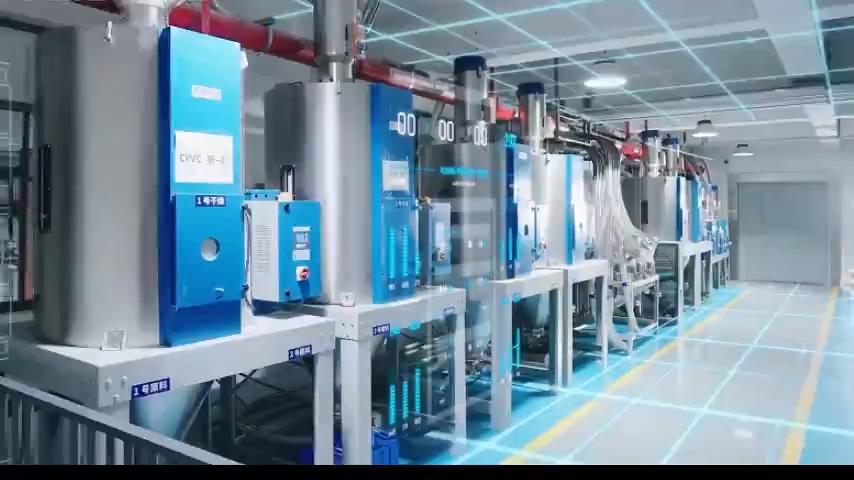
From Material Handling to Intelligent Drying
Traditional drying systems simply execute preset parameters.
Modern smart material handling systems should evolve into intelligent systems capable of:
- Sensing
- Decision-making
- Process optimization
1. Build a Material Drying Knowledge Database
Each resin grade should have its own drying profile, including:
- Recommended drying temperature range
- Maximum allowable temperature
- Target moisture content
- Typical drying curves
- Moisture sensitivity
- Thermal stability
Common materials include:
- ABS
- PC
- PET
- PA6
- PA66
- PBT
- TPU
- PPS
The database can be stored locally or updated continuously through the cloud.
This becomes the foundation of intelligent process control.
2. Real-Time Monitoring and Moisture Prediction
Modern drying should no longer rely on operator experience.
Instead, the system continuously monitors:
- Inlet air temperature
- Return air temperature
- Dew point
- Airflow
- Hopper temperature
For higher precision, an online moisture sensor (such as Near Infrared, NIR) can be installed at the hopper outlet.
This enables true closed-loop drying control.
Meanwhile, intelligent algorithms estimate:
- Remaining drying time
- Expected final moisture content
- Drying completion percentage
Operators no longer need to guess when the resin is ready.
3. Intelligent Process Optimization
Instead of requiring operators to manually determine drying parameters, the system recommends optimal settings automatically.
Automatic Recipe Recommendation
Operators simply select the resin type.
The system automatically calculates:
- Drying temperature
- Drying duration
- Target moisture level
Energy Saving Mode
If production timing allows, the system automatically selects:
- Lower drying temperature
- Longer optimized drying time
This minimizes overall energy consumption while maintaining quality.
Fast Production Mode
When urgent production is required, the system increases drying temperature within the resin’s safe operating limits.
It then calculates the shortest safe drying cycle and warns operators whenever the process approaches the material’s thermal limit.
Adaptive Closed-Loop Control
With online moisture measurement, the controller continuously adjusts:
- Temperature
- Drying time
- Airflow
This ensures the material reaches the target moisture level without over-drying or under-drying.
4. Intelligent Alarm and Full Traceability
A smart drying system should also provide comprehensive quality protection.
Overheating Protection
The system monitors resin temperature continuously.
If safe limits are exceeded, alarms are generated immediately.
Insufficient Drying Prevention
Material is not released to the molding machine until the predicted or measured moisture content meets specification.
This eliminates moisture-related molding defects before production begins.
Complete Production Traceability
Each drying batch automatically records:
- Temperature profile
- Drying duration
- Dew point history
- Moisture prediction
- Actual moisture measurement
These records can be linked directly to finished product quality for future analysis and process optimization.
Customer Benefits
By intelligently managing the relationship between drying temperature and drying time, manufacturers achieve significant advantages.
Superior Product Quality
- Eliminate silver streaks
- Prevent bubbles
- Improve surface appearance
- Increase mechanical strength
- Ensure consistent part quality
Lower Energy Costs
The system automatically finds the lowest-energy drying strategy while maintaining required moisture levels.
Higher Productivity
- Shorter material changeovers
- Accurate drying time prediction
- Improved Overall Equipment Effectiveness (OEE)
Simplified Operation
Operators simply select the material.
The intelligent system automatically determines the optimal drying process, reducing dependence on operator experience and standardizing production.
The Future of Smart Material Handling
Drying is no longer just a preparation step before molding.
It is becoming a core element of intelligent manufacturing.
By transforming the temperature-time relationship from an experience-based process into a data-driven, model-based, and AI-optimized control strategy, smart material handling systems evolve from simple material transport equipment into intelligent process management platforms.
This not only ensures consistent product quality but also reduces energy consumption, improves productivity, and creates a strong technological advantage for manufacturers embracing Industry 4.0.