




Plastic Vacuum Loader: How to Choose for Injection Molding

Plastic Vacuum Loader: How to Choose for Injection Molding
A plastic vacuum loader looks like the simplest machine in the plant. A hopper, a hose, a motor that makes suction. And yet it is quietly responsible for more unplanned stops than most molders admit — because when material stops arriving, everything downstream stops with it.
I’ve been called out to plenty of “the machine is down” emergencies that turned out to be nothing more than a clogged filter or a hose run that was 6 meters too long. This guide covers how to choose a plastic vacuum loader that actually keeps up with your presses: how to size it correctly, what the spec sheets don’t tell you, and the failure modes you’ll recognize from the floor.
What a Plastic Vacuum Loader Actually Does
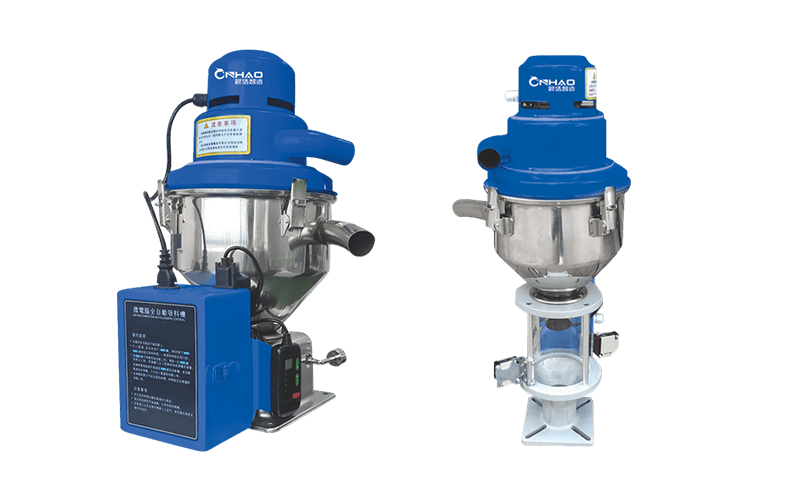
A vacuum loader moves plastic resin from a storage point — a gaylord, a silo, a drying hopper — into the next stage of your process, which is usually a dryer, a blending unit, or the machine hopper itself. It does this by pulling a vacuum in a receiving chamber, drawing material in through a hose, then discharging it through a flap once the chamber fills.
Every loader has the same five building blocks:
- Vacuum source — a motor-driven pump (brush or brushless), or a compressed-air venturi on smaller units
- Receiving hopper — the chamber where material collects before dropping out
- Filtration — keeps dust and fines out of the pump
- Material line — hose or pipe, plus the pickup wand or probe
- Control — from a simple level switch to a networked controller reporting to a central system
Choosing between them is mostly an exercise in throughput, distance, and material type.
Machine-Side Loaders vs. Central Conveying Systems
This is the first fork in the road when you specify a plastic vacuum loader, and it shapes everything else.
| Factor | Machine-side loader | Central vacuum system |
|---|---|---|
| Architecture | One loader per press, self-contained | One large pump, many receiving stations |
| Typical plant size | 1–8 machines | 8 machines to full facility |
| Upfront cost | Low per unit, scales linearly | High initially, cheaper per station later |
| Conveying distance | Short — usually under 15 m | Long — 50 m+ is normal |
| Maintenance load | Many units to service | One pump, many filters |
| Flexibility | Easy to move or add | Changes require pipe work |
| こんな方に最適 | Job shops, frequent material changes | High-volume, long runs, silo-fed plants |
A job shop running eight different materials across the week almost always wants individual loaders — you can dedicate one unit to a material and never cross-contaminate. A plant pulling from a 20-ton silo to twenty presses wants a central system, which is exactly what a separated pneumatic conveying system is built for. If you’re starting smaller, a dedicated integrated suction loading system per machine is the more forgiving choice.
How to Size a Vacuum Loader: Four Inputs
Plastic vacuum loaders are rated in kg/hr, and that single number is where most buying mistakes begin. The rating on the spec sheet is a peak figure measured under ideal conditions — short hose, low vertical lift, clean virgin pellets. Real plants have none of those things.
1. Throughput in kg per hour
Start from consumption, not from the machine’s rating. Take your shot weight, add runner and scrap, multiply by shots per hour, and that’s your true demand:
Required throughput (kg/hr) = (Part weight + runner weight) × shots per hour ÷ 1000
Then add headroom. I size so the loader satisfies demand while running at roughly 60–70% of its rated capacity. A loader asked to deliver 100% of its rating every hour will not see its first birthday.
2. Conveying distance — horizontal, vertical, and bends
Distance is the silent rating killer. Total effective distance is:
- Horizontal run, measured along the actual hose path
- Plus vertical lift, which costs several times more than horizontal
- Plus an allowance for every bend — a 90° elbow behaves like roughly 2–3 m of straight pipe
A loader rated at 400 kg/hr over 5 m might deliver barely 180 kg/hr over 25 m with two elbows and a 4 m lift. Always ask the supplier for the capacity curve, not the headline number.
3. Bulk density — the number everyone forgets
Manufacturers calibrate their ratings against a standard resin at a known bulk density. Change the material and you change the mass flow rate, sometimes dramatically:
| 素材 | Typical bulk density (kg/m³) | Effect on loading rate |
|---|---|---|
| PP pellets | 450–550 | Baseline |
| PE pellets | 550–600 | Slightly better |
| ABS pellets | 600–650 | Good |
| Regrind (flaked) | 300–450 | Noticeably worse |
| CaCO₃-filled compound | 900–1200 | Excellent mass rate, harder wear |
| PVC powder | 500–650 | Dust problems dominate |
Regrind is the trap. Its low bulk density means each suction cycle delivers less mass, so your cycle count climbs and delivered kg/hr falls — often exactly when you’re running high regrind percentages.
4. Duty cycle
A loader filling a dryer hopper that draws material for twenty seconds every three minutes is living an easy life. The same loader feeding a fast-cycling press at short intervals may run 40% of the time or more. Check the unit’s duty rating and motor specification for continuous operation, particularly on brush-type motors where brush wear becomes your recurring cost.
Choosing Pipe Diameter and Line Material
Undersized lines are the most common field retrofit I see. Common sizes are 38 mm (1.5″) for single machines and 51 mm (2″) for higher throughput or longer runs. Oversizing isn’t free either — too large a line requires more air volume to keep material moving and can cause material to stall in horizontal sections.
For abrasive materials — glass-filled compounds, mineral-filled grades, and heavy regrind — use abrasion-resistant hose or steel tubing on the long runs and expect to replace the flex sections on a schedule. Filled compounds that deliver excellent mass rates will wear elbows thin faster than you’d expect.
Pellets, Regrind, and Powder
What you’re conveying changes what you should buy:
- Virgin pellets — easy. Almost any loader handles them. Size for distance and throughput.
- Regrind — low bulk density, variable granule size, and lots of fines. Needs more filter capacity and often a larger unit than intuition suggests. If regrind is coming off your own heavy-duty crusher, screen it before it reaches the loader.
- Powder and dusty compounds — filtration becomes the whole game. You want a large filter area and automatic back-flush cleaning.
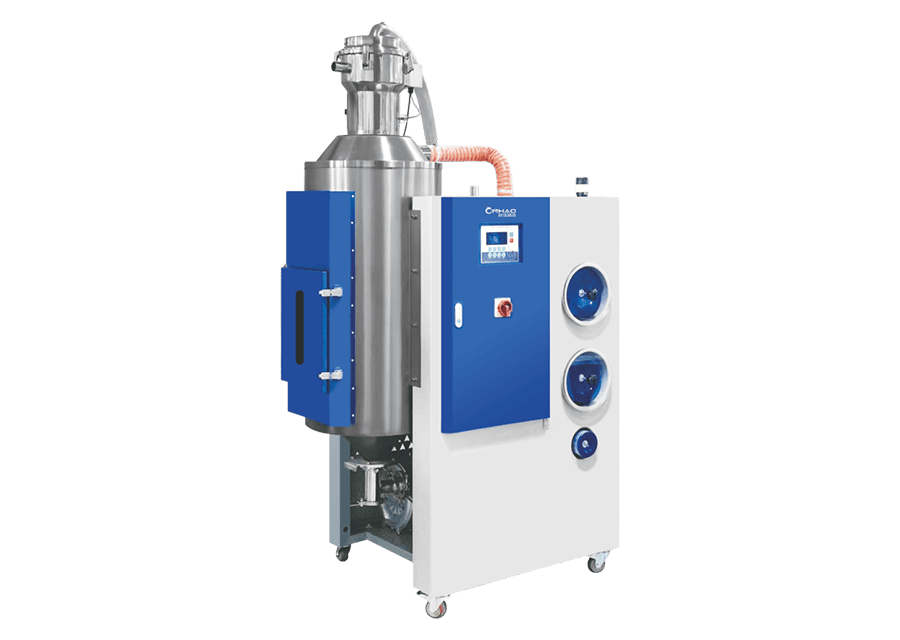
- Hygroscopic materials — the loader must not become the weak link. If you’re conveying before drying, any leak lets ambient humidity in. Pair the loader properly with your dehumidifying dryer setup so wet material never sits in a hopper that isn’t drying it.
Filtration: The Part That Decides Your Uptime
If I had to pick one component that generates the most service calls, it’s the filter. Fines slip past pickup screens, coat the filter media, and gradually strangle the airflow — throughput drops slowly enough that nobody notices until the hopper runs dry mid-shift.
Look for:
- Generous filter area relative to throughput, especially with regrind
- Automatic cleaning — reverse-air pulse or mechanical shaker, triggered after each cycle or on differential pressure
- Easy access — if changing a filter requires tools and twenty minutes, operators will delay it
Dust that makes it past the filter doesn’t disappear. It scores the pump, blocks valves, and eventually shows up as contamination in your parts.
Integrating Loaders With Drying, Blending, and Feeding
A loader is rarely a standalone decision. In a typical line, material moves from storage to dryer, then possibly to blending, then to the press. Conveying into a dual molecular sieve dehumidifier or a honeycomb rotary dehumidifier means the loader’s cycle must stay in step with the dryer’s demand signal, or you’ll starve the drying hopper and lose residence time.
If you blend upstream, think about where mixing happens. Masterbatch metered at the press behaves differently from material homogenized in a vertical color mixer or a horizontal color mixer before conveying — and regrind that passes through a large vertical mixer mixes far more consistently than anything metered in-flight.
At some point the conversation stops being about one loader and becomes about plant-wide material distribution. That’s the territory of a smart central feeding system, worth planning for even if you install machine-side units today.
Five Failure Modes You’ll Recognize
| Symptom | Usual cause | Fix |
|---|---|---|
| Hopper starves, loader runs constantly | Undersized for real distance, or blocked filter | Clean filter; re-size using effective distance |
| Material bridges in the receiver | Low-angle hopper, damp or flaky material | Agitation, vibrator, or steeper discharge cone |
| Throughput slowly degrades over weeks | Progressive filter blinding | Automatic cleaning, filter service schedule |
| Dust around the receiver lid | Leaking seals or damaged gaskets | Replace gaskets; check lid clamp |
| Pump runs hot / brushes wear fast | Duty cycle above rating | Larger unit, or move to continuous-duty motor |
Maintenance That Actually Prevents Downtime
- Daily — listen for abnormal pump pitch, glance at any filter condition indicator, check that hoses haven’t been crushed or kinked
- Weekly — clean or back-flush filters, inspect pickup wand screens, wipe receiver internals
- Monthly — check hose and elbow wear (especially with filled grades), inspect electrical terminals, verify level sensors are not coated
- Quarterly — service the vacuum pump per manufacturer intervals; on brush motors, check brush length before it becomes a failure
A Buyer’s Checklist
- Calculate real demand from shot weight and cycle time, then size to ~65% of rated capacity
- Measure the true effective distance: horizontal + vertical lift + bend allowance
- Confirm the supplier’s capacity curve at your distance, not their headline peak
- Identify every material to be conveyed, including regrind percentage and bulk density
- Specify filtration appropriate to the dustiest material you’ll run
- Decide the architecture: machine-side vs. central — and check it still fits in two years
- Confirm control integration with dryers and the injection machine
- Check spare parts availability and expected wear items before you buy
Frequently Asked Questions
How do I know what throughput I need?
Work from consumption: part weight plus runner weight, times shots per hour. That’s your demand in kg/hr. Then size the loader so demand equals about 60–70% of its rated capacity — never 100%.
Can one vacuum loader feed several machines?
Yes, with a distribution manifold and level-sensing receivers at each press, though shared units introduce sequencing delays. It works well for similar materials and predictable consumption, less well when every machine runs something different.
Should I use a machine-side loader or a central system?
Up to roughly eight presses with frequent material changes, machine-side loaders win on flexibility and cost. Beyond that — particularly with silo storage and long runs — central conveying becomes more economical per station.
Why is my loader rated 300 kg/hr but delivering 150?
Because the rating was measured under ideal conditions. Long horizontal runs, vertical lift, elbows, low bulk density regrind, and partially blinded filters all chip away at real throughput. Compare your effective distance against the supplier’s capacity curve.
Can vacuum loaders handle powder and fine regrind?
Yes, but filtration becomes critical. Fine particles blind filters quickly, so specify a unit with large filter area and automatic cleaning, and consider screening regrind before it enters the conveying line.
Where to Go From Here
If you’re specifying loaders for a new line, start with the architecture question and work backward — a decision to centralize later costs far less if pipes were planned for it now. If you’re replacing an underperforming unit, measure your effective distance honestly before shopping for a plastic vacuum loader, because that single number usually explains the shortfall.
The details of drying the resin before it reaches the press are their own subject — see our guide to choosing a PET drying system if you handle hygroscopic materials, or explore the full drying range from our integrated rotary dehumidifier.