




How Inline Grinder-Reclaim Systems Reduce Raw Material Costs in Plastics Processing

Raw material costs consistently rank as the single largest expense for injection molders, blow molders, and extrusion operators — typically 60% to 75% of total production cost. Every sprue, runner, trim scrap, and reject part that leaves the facility as waste is material you already paid for, processed, and then threw away. Inline grinder-reclaim systems close this loop: they capture production waste at the source, grind it, and feed it directly back into the process — often within the same shift. For any manufacturer looking to cut virgin resin consumption without sacrificing part quality, getting the inline reclaim strategy right is one of the highest-ROI moves on the table.
The Economics of Production Scrap: What Gets Thrown Away
Before examining the equipment, it is worth quantifying what is actually lost when scrap leaves the production floor. In injection molding, cold runner systems typically represent 15% to 40% of the total shot weight — for multi-cavity molds with generous runner dimensions, the runner can outweigh the parts themselves. Blow molding generates flash and tail scrap that can account for 20% to 35% of the parison weight. Extrusion operations produce edge trim, start-up scrap, and off-spec product that collectively represents 3% to 10% of throughput.
A mid-sized injection molding facility processing 2,000 metric tons of resin annually, with an average cold runner fraction of 25%, generates 500 metric tons of runner scrap per year. At a virgin resin cost of $1.50/kg, that is $750,000 worth of material that must either be reclaimed or paid to dispose of. Even after accounting for the degradation that occurs with each heat history, the economic case for reclaiming this material is overwhelming.
Beyond Virgin Material Savings: The Hidden Costs of Not Reclaiming
Disposing of plastic scrap is not free. Landfill tipping fees, transportation, and the labor to collect, segregate, and handle scrap all add up. In regions with extended producer responsibility legislation or plastic waste taxes, the cost of disposal is rising. On top of these direct costs, unprocessed scrap stored on the factory floor consumes valuable space, creates housekeeping and safety issues, and introduces contamination risk if the material is eventually reprocessed without proper quality controls.
Inline vs. Central Grinding: Two Architectural Approaches
Inline (Beside-the-Press) Grinding
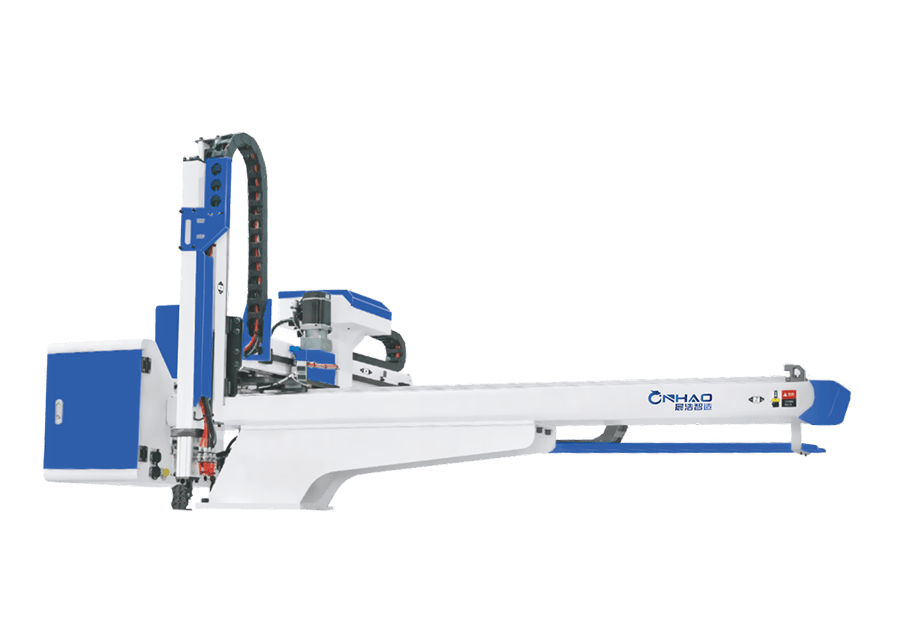
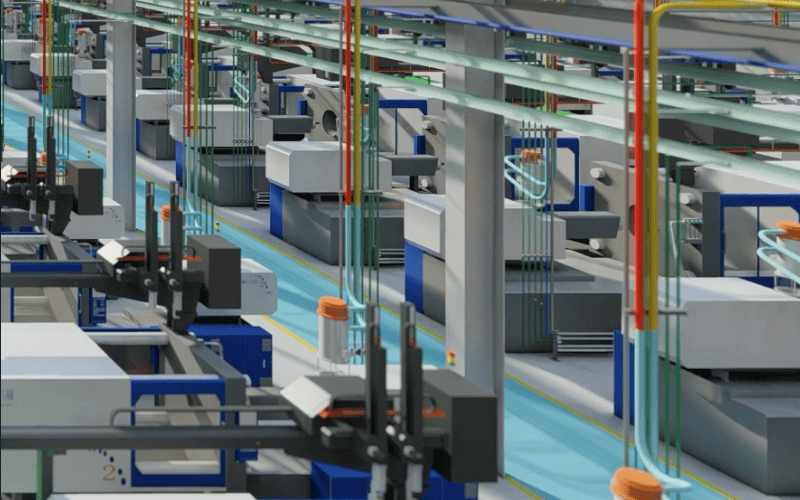
An inline grinder is positioned directly beside the processing machine — typically an injection molding machine or blow molder — and processes scrap as it is generated. A sprue picker or robot removes the runner from the mold, drops it onto a conveyor or directly into the grinder feed hopper, and the granulated material is either pneumatically conveyed back to the machine hopper or collected in a gaylord for later reuse.
The defining advantage of inline grinding is material segregation. The regrind from machine #7 running black PP stays with machine #7. There is no risk of mixing colors, grades, or polymer types — a critical consideration for facilities running diverse materials or serving customers with strict material traceability requirements. Inline systems also minimize the heat histories applied to the regrind, as material is typically reintroduced within the same shift rather than being stored, dried again, and reprocessed days or weeks later.
Central Grinding
A central grinding system collects scrap from multiple machines — either manually or via a scrap conveying system — and processes it through one or more large granulators in a dedicated grinding room. The resulting regrind is stored in bulk bins, gaylord boxes, or silos, and reintroduced into production through the central material handling system.
Central grinding offers economies of scale: one large granulator is less expensive than ten small ones, and maintenance is consolidated at a single location. However, it sacrifices material segregation — all scrap is mixed together unless strict operational discipline is maintained — and introduces additional handling steps between scrap generation and regrind reuse. Central grinding is best suited for high-volume facilities running a limited number of materials and colors, where cross-contamination risk is minimal.
Key Equipment in an Inline Reclaim System
Granulator Selection: Cutting Chamber Design
The granulator is the heart of any reclaim system, and cutting chamber geometry determines both throughput and regrind quality. Three-rotary and five-rotary blade designs with two or three stationary bed knives produce a scissor-like cutting action that generates less dust and fewer fines than the hammer-mill or impact-type size reduction found in lower-cost units. The screen — the perforated plate through which material must pass before exiting the cutting chamber — controls the maximum particle size. For most injection molding applications, a screen with 6mm to 8mm holes produces regrind that feeds smoothly alongside virgin pellets. Larger screen holes increase throughput but produce coarser regrind that may not mix uniformly with virgin material in the machine hopper.
Low-speed (25 to 150 RPM) granulators have gained market share over traditional high-speed (400 to 600 RPM) designs for inline applications. The slower rotor speed reduces dust generation, operating noise, and the risk of material overheating — a particular concern with heat-sensitive polymers such as PVC, PET, and some nylons. Low-speed granulators also consume approximately 30% to 50% less energy per kilogram processed compared to equivalent high-speed units.
Material Handling Between Grinder and Machine
Once the scrap is ground, it must be conveyed back to the processing machine. The most common approach uses a dedicated vacuum loader or venturi loader that pulls regrind from the granulator’s discharge bin or a small surge hopper and delivers it to the machine hopper. For applications where the regrind must be blended with virgin material before entering the machine, a gravimetric or volumetric blender mounted above the machine throat proportions the regrind and virgin streams according to the recipe.
A critical design consideration is surge capacity. The granulator typically operates continuously or in short bursts as scrap arrives, while the processing machine consumes material at a steady rate. A small buffer hopper between the granulator discharge and the conveying system decouples these two rhythms, preventing the conveying system from being starved or overwhelmed.
Dust Removal and Fines Management
Every grinding operation generates a certain amount of dust — microscopic particles created by the fracture of brittle materials, particularly in glass-filled or mineral-filled grades. This dust, if allowed to accumulate in the regrind stream, causes feeding inconsistencies, creates housekeeping issues, and can contaminate the melt with degraded material. Inline granulators should be equipped with a dust extraction port connected to a small cyclone separator or baghouse filter. Some advanced systems integrate an elutriator — a device that uses airflow to separate lighter dust particles from heavier regrind granules — directly into the discharge path.
Material Quality Considerations: How Many Heat Histories?
Every time a polymer passes through the melt phase — from pellet to molded part, then ground and remelted — its molecular structure undergoes some degree of change. Polymer chains shorten (chain scission), additives degrade, and the material’s mechanical properties gradually decline. The practical question for the processor is: how many times can this material be recycled before it no longer meets specification?
The answer varies significantly by polymer family. Polyolefins — PP and PE — are relatively forgiving, often tolerating five or more heat histories before tensile strength or impact resistance degrades measurably. Polycarbonate and acrylic are more sensitive; two to three cycles may be the practical limit before yellowing or embrittlement becomes visible. Nylons fall in the middle — three to five cycles is typical, though the presence of glass fiber reinforcement can accelerate degradation due to fiber attrition during grinding and remelting.
The most effective strategy for managing heat history is controlled dilution: maintain a fixed ratio of regrind to virgin material — typically 15% to 30% — so that each regrind particle cycles through the process roughly once before being consumed. At 20% regrind ratio, the average particle experiences 1.25 heat histories, well within the tolerance of most engineering resins.
Integration with Central Conveying and Drying Systems
Inline grinder-reclaim systems do not operate in isolation. In a facility with central conveying, the regrind stream must tie into the material supply network. The most common approach treats regrind as a separate component — stored in its own bin or silo — and proportions it with virgin material at the machine using a blender. This gives maximum flexibility: the regrind ratio can be adjusted per machine, per product, or per customer specification.
For materials that require drying — PET, PC, nylon, and most engineering resins — regrind introduces an additional complication. Regrind has a higher surface-area-to-volume ratio than virgin pellets and absorbs atmospheric moisture more rapidly. Worse, the heat history from the first molding cycle may have consumed some of the polymer’s hydrolytic stabilizers, making the regrind more susceptible to moisture-induced degradation during the second drying and melting cycle. Best practice: minimize the time between grinding and reprocessing, store regrind in sealed containers or under dry air purge, and verify residual moisture content before reintroduction if the regrind has been stored for more than a few hours.
Return on Investment: Quantifying the Payback
Consider a typical injection molding facility with the following parameters:
- Annual virgin resin consumption: 1,500 metric tons
- Average cold runner fraction: 20% (300 metric tons of scrap)
- Current scrap disposal: Sold to recycler at $0.30/kg
- Virgin resin cost: $1.50/kg average
- Inline grinding system investment: $45,000 per machine line × 8 lines = $360,000
Under the current model, the facility recovers $90,000 per year from scrap sales (300,000 kg × $0.30/kg) but then repurchases 300,000 kg of virgin resin at $450,000 to replace that material — a net cost of $360,000 per year.
With inline reclaim, assuming a conservative 80% of scrap is recovered as usable regrind (some losses to dust, contamination, and degradation), 240,000 kg of regrind displaces virgin resin at $1.50/kg, yielding $360,000 in annual savings. The simple payback on the $360,000 equipment investment is approximately one year.
This calculation excludes the additional savings from reduced scrap handling labor, lower disposal costs, and improved sustainability metrics — all of which strengthen the business case.
Best Practices for Implementation
1. Audit Your Scrap Stream First
Before purchasing equipment, conduct a thorough scrap audit. Weigh and categorize every source of production waste over a representative week: cold runners by material and color, reject parts by defect type, start-up and shut-down purgings, and trim scrap. This data determines the required granulator throughput capacity, the number of inline units needed, and whether any scrap streams should be excluded from reclaim due to contamination risk.
2. Segregate by Material and Color
The most common failure mode for inline reclaim systems is cross-contamination. Establish clear, physically enforced segregation between different materials and colors. Color-coded granulator hoppers, dedicated convey lines, and formal changeover procedures with documented clean-out verification prevent the “one black speck ruins a thousand white parts” scenario.
3. Invest in Dust Management
Dust is the enemy of consistent feeding, clean production floors, and employee health. Allocate budget for proper dust extraction at every grinding point, and establish regular filter cleaning and replacement schedules. A dust management system that is difficult to maintain will be neglected — choose equipment with tool-free filter access and visible dust collection bins that signal when emptying is required.
4. Establish Regrind Quality Standards
Define and document the quality specifications for regrind reintroduction: maximum particle size, acceptable dust content, allowable color variation, and maximum heat history count. Train operators and quality technicians to inspect regrind at defined intervals, and maintain lot traceability so that any quality issue in finished parts can be traced back to the regrind source.
5. Start Conservative, Then Optimize
Begin with a conservative regrind ratio — 10% to 15% — and validate part quality across multiple production runs before increasing the ratio. Monitor key quality metrics (tensile strength, impact resistance, color consistency, surface appearance) at each ratio increment. The optimal ratio is the highest level at which quality remains within specification with a comfortable safety margin.
The Role of Smart Monitoring and Industry 4.0
Modern inline grinding systems increasingly incorporate sensors and connectivity that turn the reclaim process from a blind utility into a source of real production data. Throughput monitoring tracks how much regrind is being generated per machine per shift, enabling accurate material reconciliation and cost allocation. Vibration analysis on the granulator motor and rotor bearings supports predictive maintenance scheduling, reducing unplanned downtime. Integration with the plant’s MES or ERP system enables automatic tracking of regrind-to-virgin ratios by product, providing the traceability required by automotive, medical, and aerospace customers.
Some advanced systems now incorporate near-infrared (NIR) sensors at the granulator discharge that verify the polymer type of the regrind in real time. This provides a safeguard against accidental material mixing — a feature that pays for itself the first time it prevents a batch of PP from being dumped into a PC regrind stream.
Қорытынды
Inline grinder-reclaim is one of the few capital investments in plastics processing where the math is genuinely simple: every kilogram of scrap you grind and feed back in is a kilogram of virgin resin you don’t buy. For most injection molding, blow molding, and extrusion operations, the equipment pays for itself within 12 to 24 months. After that, the savings run straight to the bottom line.
There is more to it than the raw material savings. An effective inline reclaim system cuts your environmental footprint, cleans up scrap handling logistics, and generates the material traceability documentation that automotive, medical, and aerospace customers now expect as standard. As virgin resin prices continue their long-term climb and sustainability requirements tighten across global markets, processors who treat production scrap as a recoverable asset rather than a disposal problem will operate with a structural cost advantage over those who don’t.