






How to Choose a PET Drying System: Dew Point, Time & Crystallization

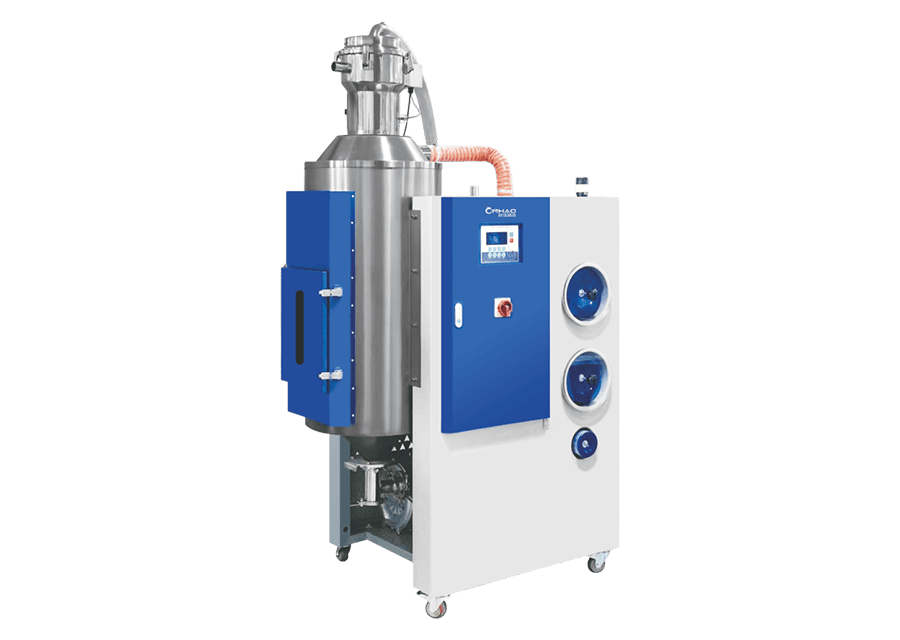
How to Choose a PET Drying System: Dew Point, Time & Crystallization
PET looks dry when it isn’t. A bottle preform that comes out cloudy, weak, or with streaks isn’t a molding problem — it’s almost always a drying problem. Here’s what actually matters when you spec a PET resin dryer, and where most plants get it wrong.
I’ve stood beside more PET dryers than I can count, and the most dangerous thing about them is that the material looks fine. You open a gaylord of PET pellets and they’re clear, dry to the touch, streaming through the hopper like glass beads. The operator swears the resin is dry. Then the preforms come out with a milky haze, the IV drops, and suddenly everyone’s blaming the mold or the screw speed.
It’s not the mold. With PET, moisture is the enemy you can’t see — and if your drying system is undersized, set wrong, or chosen for the wrong dew point, it will cost you a full shift of scrap before you ever realize what happened. Let me walk you through how to pick a PET drying system that actually does its one job.
Here’s the thing: PET is a hygroscopic resin. It doesn’t just pick up surface moisture — it absorbs water into the pellet, deep inside the polymer chain. No amount of looking at it will tell you how wet it is. Only the dew point of the air you dry it with will.
Why PET has to be dried — and why it’s unforgiving
PET holds roughly 0.2 to 0.3% moisture by weight when it’s just sitting in a humid warehouse. That doesn’t sound like much. But the moment that resin hits the melt temperature, the water molecules split the polymer chains apart. The result is a drop in intrinsic viscosity — the IV number your customers care about — and a stream of hydrolysis that shows up as cloudy parts, weak walls, and haze you can’t polish out.
Here’s the number to hold in your head: to mold PET properly, you need it down to 50 parts per million (0.005%) or less of moisture. Below that, and only below that, will the polymer hold its IV and mold into parts with the clarity and strength you’re paying for. Anything above 50 ppm and you’re gambling with every single preform.
The three numbers that define any PET drying system
Every PET drying system worth installing is built around three parameters. If your supplier can’t give you all three in writing, walk away. If your current system runs outside them, that’s your problem.
Dew point of the process air: ≤ −40°C
The single most important number. PET demands a dew point of −40°C or lower — that’s the dryness of the air being pushed through the hopper. A dryer at −20°C simply will not get PET down to 50 ppm, no matter how long you run it. This is non-negotiable.
Drying temperature: 160–180°C
PET needs heat to drive the absorbed moisture out. The sweet spot is around 170°C. Go too cold and drying crawls; drift toward 180°C+ for long stretches and you risk thermal degradation of the resin itself.
Drying time: 4–6 hours of residence
Unlike many resins that dry in an hour or two, PET needs its residence time — typically 4 to 6 hours in the hopper. This is why the hopper is sized so much bigger than the machine’s hourly consumption. Skimp on residence and you dry the outside of the pellet and leave the core wet.
Read those three again, because they explain every PET drying failure I’ve ever seen. People buy a dryer rated for a different resin, set it to a temperature that works for ABS, run it for ninety minutes because that’s what the last machine needed — and then wonder why the parts are hazy.
Amorphous vs. crystalline: the question most buyers skip
Here’s where PET gets different from everything else in the drying room. There are two forms of PET, and they dry in completely different ways.
Amorphous PET — the clear, glassy pellets used for bottle preforms — has a glass transition around 75°C. If you try to dry it above that temperature without a crystallizer, the pellets soften, stick together, and bridge in the hopper. You’ll get a solid lump where your material should be.
Crystalline PET — already partially crystallized, often recycled or flake — can handle higher temperatures and shorter residence times. This is where a PET crystallizer comes in: a separate unit that heats amorphous PET slowly to crystallize it before it hits the dryer, so you can dry it fast and hot without it clumping.
Bottom line up front: If you’re drying amorphous PET pellets for preforms, you need a drying system that includes crystallization protection (or separate crystallizer) and a resin dryer that keeps the bed moving so nothing sinters. If you’re drying flake or rPET, the rules shift — but you still need that −40°C dew point.
What type of PET dryer should you actually use?
Not every dryer can reach −40°C dew point. That single fact eliminates most of the market before you even compare prices.
Hot-air dryers blow ordinary air heated to 170°C through the hopper. They’re cheap, but the air they use has whatever dew point the room has — often −10°C or worse. A hot-air dryer physically cannot dry PET to 50 ppm. It’s the wrong tool, full stop, and I’ve seen entire production lines built around one because “it was already on the floor.”
Desiccant dryers — specifically honeycomb-rotor or desiccant-bed dryers — pass the process air through a desiccant that pulls it down to −40°C or lower. This is the class of machine a PET drying system needs. The desiccant is regenerated continuously so you get a steady dew point shift after shift.
Vacuum dryers are the newer, energy-savvy option: they pull moisture out under vacuum instead of heating with dry air. They can be dramatically more efficient for PET, especially for large central systems. The trade-off is a higher upfront cost and a longer dry cycle in some configurations.
If a supplier tries to sell you a hot-air dryer for a PET line, thank them and move on. If they quote a desiccant or vacuum system that holds −40°C with a 4–6 hour residence hopper, you’re on the right track.
The failure that looks like a molding problem
Let me tell you about a plant I helped pull out of a hole. They were molding preforms and getting intermittent haze — a few bad shots an hour, enough to scrap maybe 8% of output. The team had spent two weeks changing screw speeds, tweaking mold temperatures, even swapping resin suppliers. Nothing helped.
We walked the drying line and found the real story in about twenty minutes. Their desiccant dryer’s regenerated air had crept up to about −25°C. It wasn’t broken — the desiccant was just past its useful life, so the dew point had drifted. At −25°C, the resin was coming out at maybe 80–100 ppm instead of 50. Not enough to fail everything, just enough to poison a handful of preforms every cycle.
That’s the insidious thing about PET: a marginal drying system doesn’t fail loudly, it fails quietly in the parts you don’t inspect. The fix was a desiccant rebuild and a dew-point alarm that shuts the line down if the air drifts above −35°C. They’ve run clean since.
How to size a PET drying system for your line
Sizing comes down to one calculation most people get backwards: the hopper must hold 4–6 hours of your machine’s hourly material use, not an hour’s worth.
- Start with throughput. If your press uses 80 kg/hour of PET, a 4-hour residence means you need roughly a 320–480 kg hopper. That feels oversized until you realize there’s no shortcut.
- Match the dryer to the hopper, not the press. The desiccant or vacuum unit must be able to hold −40°C while pushing enough air volume (CFM) for the full hopper. Undersize the air and the dew point collapses the moment you push throughput.
- Ask about residence-time automation. A good system tracks how long material has been in the hopper and tells you when it’s truly dry, instead of running on a fixed timer that assumes the hopper was full.
- Plan for regrind. If you’re feeding preform regrind or rPET flake, tell your supplier. Flake packs differently, dries differently, and often needs a separate hopper with its own dew-point control.
The maintenance that keeps your PET dry
Once it’s set up right, a PET drying system doesn’t ask for much — but the few things it needs are the ones people skip:
- Check the dew point daily, not weekly. It’s the single best early-warning number you have. If it drifts above −35°C, stop and fix it before you run a batch.
- Rebuild the desiccant on schedule. Rotor or bed desiccant doesn’t last forever. Track hours and replace before the dew point starts creeping, not after.
- Clean the hopper when you change materials or colors. Leftover PET from the last run, degraded at 170°C, will contaminate the next batch and lower your IV.
- Keep the filters clean. A dusty process-air filter drops airflow, which drops your ability to hold dew point at full residence.
- Install a dew-point alarm tied to the line. It should be loud and it should stop production. A few minutes of downtime to fix dryness beats a shift of hazy scrap.
PET drying questions, answered straight
What dew point does PET require?
At least −40°C, ideally lower. This is what gets PET down to the 50 ppm (0.005%) moisture it needs for stable IV and clear parts. Below −40°C is your safety margin.
What temperature should you dry PET at?
Around 170°C is the safe operating zone. Drying below that crawls; sustained temperatures above ~180°C risk thermal degradation and a drop in IV.
How long does PET take to dry?
Plan for 4 to 6 hours of residence time in the hopper. This is why the hopper is sized for hours of throughput, not minutes — the outside of the pellet dries fast, the core needs time.
Can I use a hot-air dryer for PET?
No. Hot-air dryers can’t reach the −40°C dew point PET needs, so the resin won’t get below the moisture threshold. Use a desiccant or vacuum PET drying system.
Why do PET parts come out hazy even after drying?
Usually the dew point drifted up or the residence time was too short — both leave moisture in the core of the pellet, which hydrolyzes in the melt and clouds the part. Check dew point first.
So what should you actually buy?
Buy a PET drying system that holds a −40°C (or lower) dew point reliably, sizes its hopper for 4–6 hours of residence, and protects amorphous PET from sintering — either with crystallization protection or a separate crystallizer. Add a dew-point alarm that stops the line, and schedule the desiccant rebuild the way you schedule an oil change: on time, before it fails.
Everything else is marketing. A drying system that hits those three numbers will keep your PET dry, your IV stable, and your parts clear. One that doesn’t will quietly eat your yields while it looks perfectly fine from the outside.
One more honest note: If you’re building or expanding a PET line, get the drying system spec’d by someone who knows hygroscopic resins — and make them put the dew point, temperature, and residence time in writing. PET doesn’t forgive a guess. Get those three right and the rest of your line will show it.