




The Role of Gravimetric Blenders in Reducing Material Waste and Production Costs

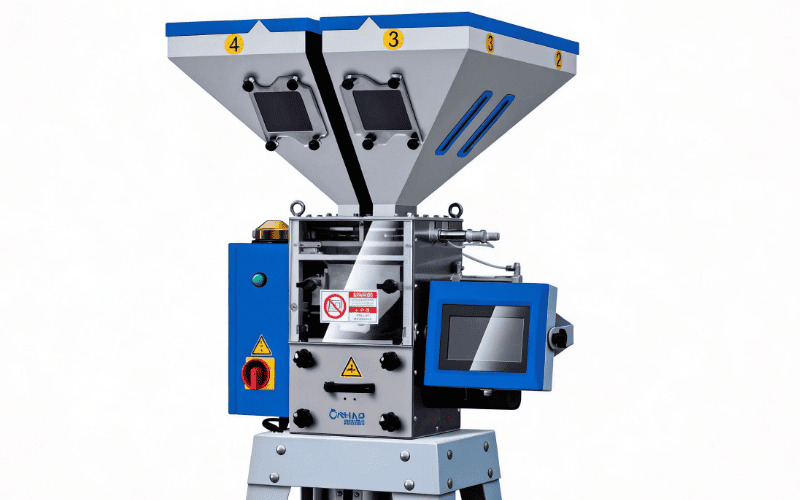
In plastics processing and compounding, raw material costs account for a substantial portion of total production expenses — typically 60% to 75%. For manufacturers operating on thin margins, even a 1% to 2% deviation in material dosing can translate into tens of thousands of dollars in annual waste. Gravimetric blenders have emerged as the gold-standard solution for precise material proportioning, and their adoption is accelerating across injection molding, blow molding, and extrusion operations worldwide.
How Gravimetric Blending Differs from Volumetric Dosing
Traditional volumetric blenders dispense materials by volume — typically using screw feeders or rotary valves timed to deliver a fixed amount per cycle. While simple and inexpensive, volumetric systems are inherently vulnerable to material density variations, bridging in the hopper, and inconsistent flow characteristics. A batch of regrind with higher bulk density than virgin pellets will deliver more actual material per volumetric “shot,” throwing off the recipe without any alarm or correction.
Gravimetric blenders solve this by measuring each component by weight, not by volume. A load cell continuously monitors the actual mass dispensed into the weigh hopper, and the controller dynamically adjusts dosing time on every cycle to hit the target weight. The result is batch-to-batch consistency that volumetric systems simply cannot match — typically achieving ±0.1% to ±0.5% accuracy depending on the model and material type.
Quantifying the Waste: Where the Money Gets Lost
1. Over-Dosing of Expensive Additives
Color masterbatch, UV stabilizers, flame retardants, and impact modifiers are the most expensive components in most recipes — often costing 5× to 20× more per kilogram than the base polymer. A volumetric system that over-doses a 2% masterbatch recipe by just 0.3 percentage points (delivering 2.3% instead of 2.0%) wastes approximately 15% more additive than required. For a mid-sized operation consuming 10 metric tons of masterbatch annually at $5/kg, that single error represents $7,500 in unnecessary costs per year.
2. Quality Failures from Under-Dosing
Under-dosing critical additives — particularly UV stabilizers for outdoor products or flame retardants for electrical components — produces parts that meet dimensional specifications but fail in service. The cost of a recall, warranty claim, or lost customer far exceeds the savings from any dosing system. Gravimetric blenders provide batch logs and alarm functions that make under-dosing events immediately detectable and correctable.
3. Regrind Utilization Optimization
One of the highest-ROI applications for gravimetric blenders is regrind reintroduction. Volumetric systems force operators to use conservative (low) regrind percentages because density inconsistency makes accurate dosing unreliable. A gravimetric blender allows operators to push regrind ratios closer to the process limit — often increasing from 15% to 25% or more — without risking part quality. At virgin resin prices of $1.20 to $2.50/kg, recovering an extra 10% regrind on a line running 500 kg/hour saves $60 to $125 per hour of operation.
Key Features to Evaluate When Selecting a Gravimetric Blender
Weigh Hopper Design and Load Cell Quality
The load cell is the heart of any gravimetric system. Industrial-grade blenders use temperature-compensated strain gauge load cells with resolution of 0.1g or better for small components and 1g for bulk materials. Look for systems that isolate the load cell from vibration and thermal drift — poorly isolated cells produce noisy readings that force slower, more conservative dosing cycles.
Number of Components and Throughput Range
Batch blenders typically support 2 to 8 components. The key specification is not just the maximum throughput (e.g., 600 kg/h) but the turndown ratio — the range between minimum and maximum batch size where accuracy remains within specification. A blender rated for 100–600 kg/h with a 6:1 turndown ratio will struggle at the low end; look for models with 10:1 or better if your production involves frequent material or color changes.
Control System and Data Integration
Modern gravimetric blender controllers offer Ethernet/IP, Profinet, or Modbus TCP connectivity, enabling integration with plant-wide MES or ERP systems. Batch-by-batch data logging — recording actual vs. target weights for every component in every cycle — provides the traceability increasingly demanded by automotive, medical, and aerospace customers. Some systems also support remote recipe management, allowing centralized engineering teams to push validated recipes to multiple machines across different plants.
Self-Calibration and Diagnostics
The best systems include automated calibration routines that run during normal operation — periodically checking the load cell zero point and, on some models, verifying against a known reference weight. Diagnostic functions that monitor valve response time, material flow consistency, and cycle time trends provide early warning of maintenance needs before they cause downtime.
Integration with Auxiliary Equipment Systems
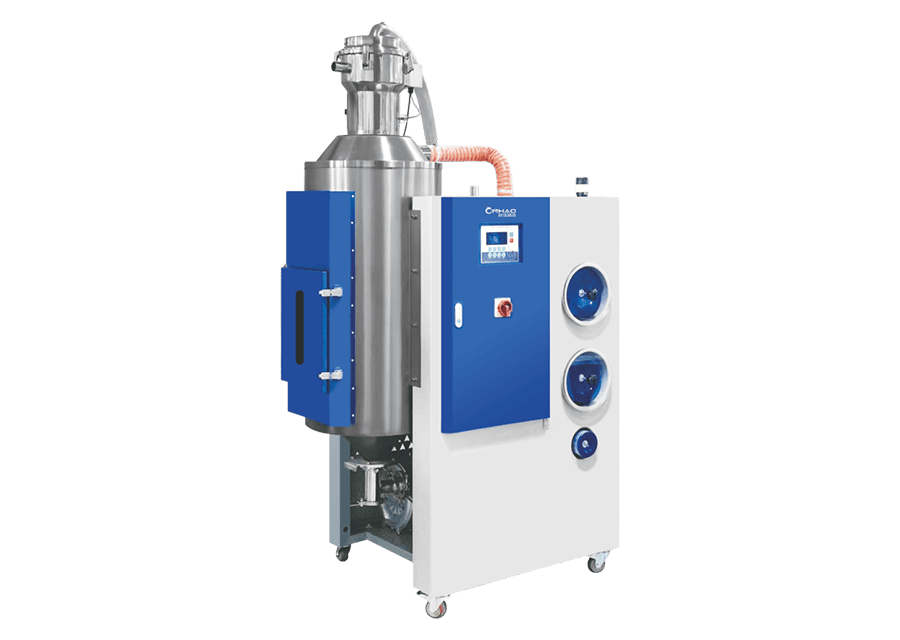
Gravimetric blenders rarely operate in isolation. In a typical installation, the blender sits above the processing machine throat, receiving material from a central drying and conveying system while feeding directly into the extruder or injection unit. Coordinating the blender cycle with the machine cycle is essential — the blender must complete its weigh-and-dispense sequence before the next machine shot, or the process stalls.
For high-throughput extrusion lines, continuous loss-in-weight blenders offer an alternative to batch systems. Instead of discrete weigh-dump cycles, each component feeder continuously loses weight at a controlled rate, with the controller adjusting feeder speed in real time. Continuous systems are more expensive but essential for applications where even momentary composition variation is unacceptable, such as medical tubing or optical film.
Return on Investment: A Practical Calculation
Consider a typical mid-sized injection molding operation running 20 machines, each consuming 30 kg/h of material with an average additive cost of $3/kg at 5% loading:
- Annual material throughput: 20 machines × 30 kg/h × 6,000 hours = 3,600,000 kg
- Additive consumption at 5%: 180,000 kg/year
- Volumetric over-dosing (conservative 0.5% excess): 18,000 kg of wasted additive
- Annual waste cost: 18,000 kg × $3/kg = $54,000
- Gravimetric blender investment (20 units at ~$12,000 each): $240,000
- Simple payback period: $240,000 ÷ $54,000 ≈ 4.4 years
This calculation uses conservative assumptions and does not include savings from increased regrind utilization, reduced scrap from formulation errors, or avoided quality claims. In practice, most operations achieve payback in 2 to 3 years, with ongoing savings flowing directly to the bottom line thereafter.
Fazit
Gravimetric blenders represent one of the most reliable and quantifiable ROI investments available to plastics processors today. The transition from volumetric to gravimetric dosing eliminates the hidden costs of material over-consumption, reduces scrap and quality risk, and provides the data traceability that modern supply chains require. For any operation where raw material costs exceed $500,000 annually, a gravimetric blender upgrade program should be a priority capital expenditure.