






Volumetric vs Gravimetric Dosing: How to Choose the Right One


A customer rejects a batch for color drift. The operator does a catch test on the doser, weighs what came out, and gets 2.4% when the recipe says 2.0% — yesterday it read 1.8%. The quality manager wants gravimetric dosing. The plant manager looks at the price difference and asks a fair question: is the color really worth doubling the cost of a doser?
Sometimes yes, sometimes no — and the deciding factor is almost never the accuracy number on the datasheet. It’s how much a dose that wanders actually costs you, and how often your material changes underneath the calibration. Here is how to work through volumetric vs gravimetric dosing properly, with the math and the honest cases where volumetric still wins.
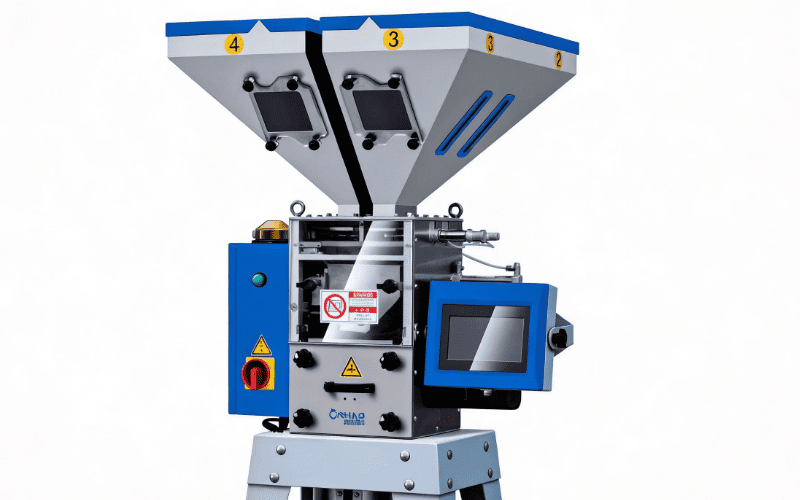
Gravimetric dosing self-corrects; volumetric dosing assumes the pellet never changes.
>What Each Technology Actually Measures
A volumetric doser meters material by a rotating auger. Once calibrated, the controller assumes each screw revolution delivers a known volume of material. It is open-loop: it commands a speed and trusts the result.
A gravimetric doser sits on a load cell and measures the mass that actually leaves the hopper — either batch by batch (weigh-bin blenders) or continuously (loss-in-weight feeders). The controller compares actual weight against target and corrects itself every cycle. It is closed-loop.
That one difference — assumes vs verifies — drives everything else: accuracy, calibration workload, tolerance to material variation, and price.
Real-World Accuracy Numbers
Datasheets quote accuracy under laboratory conditions. Here is what plants actually see:
| Factor | Volumetric doser | Gravimetric doser |
|---|---|---|
| Typical accuracy, stable material | ±1–3% | ±0.1–0.5% |
| When bulk density shifts | Drifts until recalibrated | Auto-corrects within a cycle |
| Effect of hopper fill level | Measurable drift as hopper empties | None |
| Calibration workload | Catch test every 2–4 weeks, per material | Self-calibrating via load cell |
| Sensitivity to vibration | Moderate | Needs vibration-isolated mounting |
| Relative purchase cost | 1× | ~1.5–2× |
The volumetric number deserves one defense: on a single, consistent, free-flowing masterbatch grade that runs for weeks, a well-maintained volumetric doser holds ±1% and nobody complains. The drift stories — the 2.4% catch test — come from changeovers, new masterbatch lots with different pellet bulk density, and humid seasons. In other words, from real plants.
The Math That Decides It: Cost of Variation
Compare the price tags and volumetric wins. Compare the total cost of a wandering dose and the answer flips for most plants running expensive additives. Three cost lines to run before you decide:
1. Overdosing. Masterbatch at $6/kg, let-down ratio 2%, plant consumption 100 kg/h, 6,000 h/year. Annual masterbatch spend at exactly 2.0%: 2% × 100 × 6,000 × 6 = $72,000. A volumetric unit running 0.3% rich (half its tolerance band) costs an extra $10,800 per year — on one machine. A gravimetric doser holding ±0.3% of target cuts that to a rounding error.
2. Scrap from color variation. If off-shade parts are 0.5–1% of production and your reject rate for color is halved by closed-loop control, that saving alone often pays the doser premium within a year — the same mechanism we quantified in how gravimetric blenders reduce material waste.
3. Calibration labor. A catch test is 20–30 minutes per machine per material. A plant with 10 machines, 3 material changes each per month, and an hourly rate of $30 spends roughly 150–190 hours/year — $4,500–5,700 — keeping volumetric dosers honest. Gravimetric units eliminate most of that.
The full method, including regrind streams and recipe storage, is in our gravimetric blender selection guide.
When Volumetric Dosing Wins (and It’s Not Just About Price)
An honest comparison has to say this clearly: gravimetric is not automatically the right answer.
Choose volumetric when:
- One or two stable, free-flowing grades run for weeks between changeovers
- The product tolerates visible color variation — trash bins, cable ducts, non-visible technical parts
- The additive is cheap (calcium carbonate, basic black masterbatch) so overdosing costs cents, not dollars
- Budget or delivery time is the binding constraint
- The plant has disciplined operators who actually run the catch tests
In these cases the extra cost of gravimetric buys precision nobody bills for. That is not a compromise — it’s correct engineering economics.
Choose gravimetric when:
- Masterbatch or additives cost more than ~$3–4/kg, or the let-down ratio is below 1% where small errors are a large share of the dose
- Color or additive concentration is part of the customer specification (automotive trim, packaging, medical, consumer electronics)
- Materials or colors change frequently — every changeover silently invalidates a volumetric calibration
- The recipe includes regrind whose percentage must be controlled, not eyeballed
- You need material consumption data for costing, traceability, or an MES — gravimetric units generate it for free, as we covered in gravimetric blending benefits and applications
The Spec Sheet Number Nobody Reads: Minimum Dosing Rate
Most buyers check maximum throughput and stop. For dosing, the number that decides whether the machine works at all is the minimum dosing rate.
A recipe dosing 0.3% additive into an 80 kg/h stream needs 0.24 kg/h. That is a trickle. If the smallest auger step in the doser is coarser than the target dose, the controller rounds, and concentration oscillates shot to shot — showing up later as the color streaks we diagnose in the injection molding defects guide.
Rules that prevent this:
- Size the doser for maximum line throughput plus 15–20% margin, then check the minimum rate against your smallest recipe component — both ends of the curve
- Below ~0.5% dosing, ask for a micro-dosing auger or a gravimetric unit with high-resolution load cells
- Match auger geometry to pellet size and bulk density; one auger does not fit all materials
Dosing Is Not Blending
A doser puts the right amount of masterbatch into the stream. Whether it ends up evenly distributed in the part is a separate question, answered by the mixing stage and the machine screw. If you dose accurately but still see streaks, the problem is usually downstream — static mixing, insufficient shear in the screw, or masterbatch that segregates from the resin during conveying because the pellets differ in size and density.
We cover the mixing side — vertical mixers, ribbon blenders, and how much mixing energy a color actually needs — in the plastic color mixer and masterbatch blending machine guide.
Six Mistakes We See in Dosing Enquiries
- Comparing purchase price instead of cost of variation (the three cost lines above)
- Sizing on average throughput, then under-dosing during peak production runs
- Ignoring minimum dosing rate on low-let-down recipes
- Mounting a gravimetric unit where a machine’s vibration reaches the load cells, then wondering why it “can’t hold zero”
- Recalibrating the volumetric doser when the masterbatch lot changes — but not writing down which calibration belongs to which lot
- Assuming a blender fixes a dosing problem, or a doser fixes a blending problem — they are different failures with different fixes
What to Put in Your Enquiry
Send this and any supplier can quote the right machine, volumetric or gravimetric:
- Main material throughput in kg/h, at maximum production rate
- Every recipe component with its percentage — flag the smallest one
- Bulk density and pellet form of each component (pellets, powder, flake, regrind)
- Changeover frequency: materials, colors, and recipes per week
- What the dosing controls: feed throat of the press, extruder, or central blender
- Accuracy the product actually requires — from the customer spec, not from instinct
- Whether consumption data must feed an MES or costing system
The equipment options for both routes, including machine-side blenders for multi-component recipes, are in our dosing and blending equipment category.
Frequently Asked Questions
Is gravimetric dosing always more accurate than volumetric?
On paper, yes — ±0.1–0.5% versus ±1–3%. In practice, a neglected gravimetric unit mounted on a vibrating platform can be worse than a well-maintained volumetric doser on a stable one. Installation discipline matters as much as the measuring principle.
How often should a volumetric doser be calibrated?
Every 2–4 weeks under stable conditions, and immediately after any material, masterbatch lot, or let-down ratio change. The calibration method — a timed catch test weighed on a scale — takes 20–30 minutes per machine.
Can a gravimetric doser handle powder or flake?
Powders and flakes stress both technologies: powders bridge and flood, flakes interlock. Gravimetric units handle them better because they compensate for inconsistent feed, but the hopper and auger must be specified for the material — flag it in the enquiry, don’t assume.
Does gravimetric dosing slow down production?
No. Dosing happens during screw recovery, not during injection, so cycle time is unaffected. Gravimetric units dose and verify in the same window a volumetric unit uses.
When is volumetric dosing the better engineering choice?
When material is consistent, recipes are simple, changeovers are rare, the additive is cheap, and the product tolerates visible variation. Paying for closed-loop precision nobody’s specification requires isn’t rigor — it’s waste.
What’s the difference between a gravimetric doser and a gravimetric blender?
A doser adds one or two components to the main stream; a blender weighs every component of the recipe, including virgin resin and regrind, into a single batch. Blenders are for multi-component recipe control, dosers for adding masterbatch or additive at the throat.
Bottom Line
Choose dosing the way you choose any instrument: by the cost of being wrong. If the dose wandering ±2% costs more per year than the price difference between the two machines, gravimetric pays for itself and you should stop debating. If your materials are stable, your recipes simple, and your additives cheap, volumetric dosing is not a compromise — it’s the correct choice, and 30 minutes of catch-test discipline per month keeps it honest.
Dosing sits inside a larger material-preparation picture. For how it connects to conveying, drying, and full plant layout, see the plastic auxiliary equipment complete guide.