




Central Conveying Systems: What Actually Matters When You’re Setting One Up

Nobody walks into a factory and gets excited about how the plastic pellets get from the silo to the machine. But spend a few years on the floor and you learn this: when the conveying system has a bad day, the whole plant has a bad day. Machines starve, material gets contaminated, and suddenly you have three operators standing around while production waits.
I have seen too many plants buy a central conveying system based on a glossy brochure, only to spend the next two years fighting it. This article covers what I wish someone had told me before the first one went in.
What a Central Conveying System Actually Is
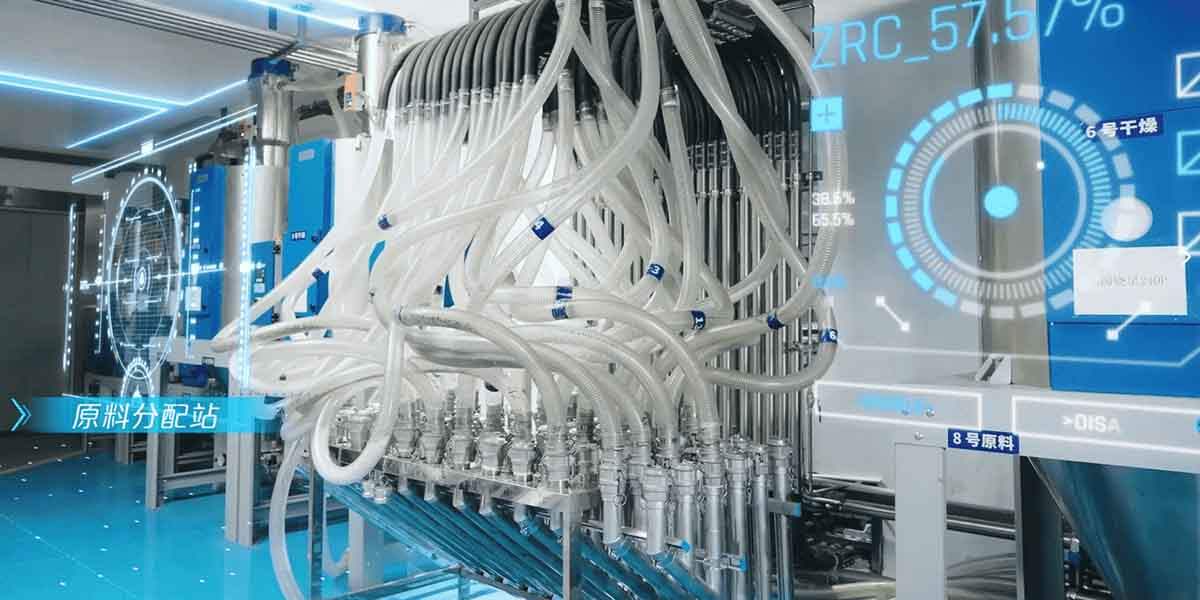
Strip away the marketing language and a central conveying system does one thing: it uses vacuum to move plastic pellets, regrind, or powder from a central storage area through sealed pipes to wherever they are needed on the production floor. No bags. No buckets. No operator hauling 25-kilo sacks up a ladder to a machine hopper.
The parts are not complicated:
-Vacuum pump (blower): Pulls negative pressure to move material. Single-pump setups work for smaller plants; multi-pump for larger ones.
-Material receivers (loaders): Sit on top of each machine or drying hopper. When the machine needs material, the receiver opens and vacuum does the rest.
-Conveying pipe: Stainless steel or aluminum. The diameter, bend radius, and how you route it matter way more than the pump spec.
-Central filter / dust collector: Pulls fines out of the air before they hit the pump. Skip this and you will be rebuilding vacuum pumps.
-Material selection station (MSS): A manifold that switches between material sources — virgin, regrind, masterbatch — and routes each one to the right destination.
-PLC control panel: Runs the show. A decent PLC logs material usage per machine, tracks conveying cycles, and can talk to the plant’s SCADA or MES if you have one.
Why You’d Switch from Manual Loading
If your plant still loads material by hand, you already know the problems. Bags everywhere. Pellets on the floor. Operators walking regrind across the plant in buckets. Someone always forgets which material went into which machine and you spend an afternoon chasing a contamination issue through six batches.
Here is what the numbers actually look like:
| Cost Factor | Manual Loading | Central Conveying
| Labor per shift (material handling) | 1-2 people dedicated | 0.1-0.2 FTE (monitoring only)
| Material waste (spills, contamination) | 1-3% of throughput | Under 0.1% |
| Cross-contamination risk | High (open containers, manual switching) | Very low (sealed, dedicated lines)
| Machine starvation downtime | 2-5% of production time | Near zero |
| Floor space for material staging | 10-15% | 3-5% (storage moves elsewhere)
A plant with 20 injection molding machines can easily burn $40,000-60,000 a year just on manual material handling labor. A properly sized central system pays itself off in 18 to 30 months — sometimes faster if your material waste is bad.
What Changes After You Install One
The things nobody mentions in the spec sheet:
The floors stay clean. This sounds trivial. It is not. When you stop spilling pellets at every machine, the whole plant looks different. Customer audits go better. ISO inspectors have less to write up. Operators stop tracking regrind dust into the break room.
You actually know how much material each machine uses. The PLC logs consumption per shift. If machine #7 suddenly pulls 8% more material than last week, you catch it immediately — process drift, a worn screw, a leak — instead of finding out at month-end when inventory does not reconcile.
Operators become operators again. When someone is not spending a third of their shift hauling material, they pay attention to quality. They catch defects earlier. They adjust parameters. They do the job you actually hired them for.
Designing One That Works
The most expensive mistake: buying a system sized for theoretical throughput instead of what the floor actually does.
Start With Your Real Material Flow
Forget equipment catalogs for a minute. Write down what is happening right now:
– How many machines need material? Count every one. Do not forget the auxiliaries.
– What does each machine actually run? Not what the spec says — what goes in the hopper today.
– What is the real consumption rate? Pull production records, not machine manuals.
– How many material changeovers per shift? If you switch resins six times a day, your selection station needs to handle that without backing up the whole line.
– What are the actual pipe runs? Measure it. Do not guess. The difference between 40 meters and 65 meters changes your pump spec.
Each receiver’s demand changes with material type — powder and regrind need more vacuum than virgin pellets. Longer pipe runs and higher vertical lifts increase the requirement. For a 15-20 machine plant with pellets under 100-meter runs, a 7.5-15 kW pump usually lands in the right range. But do not take a sizing chart as final. Make the supplier verify against your actual layout.
Pipeline Routing: What Gets Overlooked
Pipes look simple. They are not. Five things that prevent most of the problems I have seen:
– Long-radius bends, 5D minimum.Tight elbows create “roping” — pellets bunch up on the outer wall, wear through the pipe, and arrive in surges instead of a steady stream. Long-radius bends keep material moving evenly.
– No horizontal runs over 30 meters without a booster.Material settles at the bottom of long horizontal sections. If you cannot avoid it, add a booster valve or split the line.
– Slight slope on vertical risers, 2-3 degrees. A dead-vertical riser works fine while the pump is running, but material falls back when it stops. A slight slope stops the backflow.
– Clean-out access every 15-20 meters. You will use these. Color changes, material switches, the occasional blockage — all of them need access. Put them in during construction. Retrofitting is a nightmare.
– Ground everything. Plastic pellets moving through pipes generate serious static. Ungrounded systems cause dust explosions and material sticking. Every metal pipe section gets bonded and grounded. Do not skip this.
Material Selection and Cross-Contamination
If you run clear and colored materials in the same plant, or switch between incompatible resins, the material selection station is where it all goes right or wrong.
A proper MSS setup:
– Quick-connect stations with RFID. The system checks that the right material source is docked before it starts a conveying cycle. No more “I thought that was the natural ABS line.”
– Purge cycles between changes. A short compressed-air blast through the line clears residual pellets. Simple. Effective. Often skipped because someone is in a hurry.
– Dedicated lines for incompatible materials. Running PA (nylon) and PET in the same plant? Give them separate lines. Nylon contamination in PET produces black specks and brittleness. PET in nylon causes hydrolysis — the material literally degrades from moisture released during processing. The cost of a separate line is less than the cost of scrapping one contaminated production run.
Problems You Will Run Into
Angel Hair and Streamers
Those wispy plastic strands inside the pipe — they happen when pellets scrape the pipe wall fast enough to melt the surface from friction.
Fix it by:
– Dropping conveying velocity to 18-22 m/s for pellets. Faster is not better.
– Using long-radius bends everywhere.
– Checking pipe sizing. Undersized pipe forces higher velocity.
– Considering shot-peened or electropolished pipe interiors for materials that are especially prone to it.
Material Bridging
Bridging is when material arches inside the hopper and blocks flow, even with material sitting above it. Regrind and powder are the worst offenders — inconsistent particle size makes it almost guaranteed.
Fix it by:
– Adding vibrators or fluidizers on hoppers handling regrind or powder.
– Using hopper cones at minimum 60 degrees from horizontal. Shallower angles bridge.
– Installing level sensors that alarm before the bridge starves the machine.
Uneven Material Delivery
Some machines keep running out while others sit full. This is almost always the PLC’s conveying priority logic. Demand-based sequencing fixes it — the machine with the lowest level gets the next cycle, not whoever is next in a fixed rotation.
Dust and Fines
Every conveying cycle makes some dust. Pellets hit pellets. Pellets hit pipe walls. Without proper filtration, those fines end up in the machine throat and eventually show up in parts as black specks.
Fix it by:
– Putting a cyclone separator before the central filter.
– Sizing the filter for real dust load, not the theoretical number on the datasheet.
– Replacing filter elements on a schedule. Do not wait for the pressure-drop alarm — by then it has already been choking the system for days.
Conveying and Drying Together
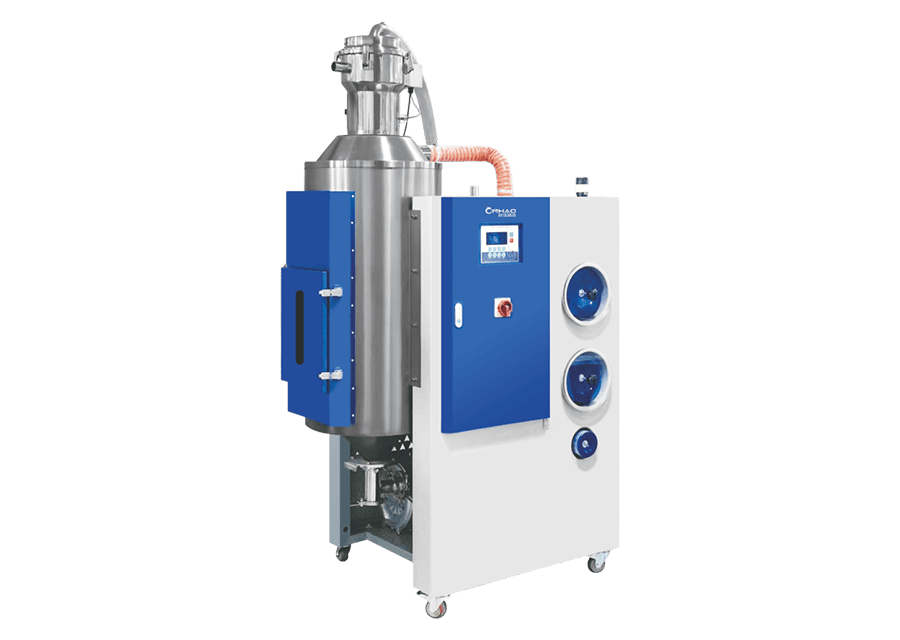
Most plants run conveying and drying as separate systems. This creates a gap most people do not think about: after material leaves the dryer, it sits in an open hopper on the machine. For hygroscopic resins — PET, PA (nylon), PC, PBT — 15 to 30 minutes of ambient exposure is enough to push moisture back above the processing limit. Your dryer did its job. Then the material sat there and picked up moisture again before it ever reached the screw.
The better approach:
1. Material arrives from silo → conveyed to central dryer
2. Dried to target moisture (under 0.003% for PET, under 0.02% for most nylons)
3. Conveyed in a closed, dry-air-purged line straight to the machine throat
4. Machine hopper is just a small buffer, with a dry-air blanket maintaining dew point
Costs more upfront. Eliminates the single biggest cause of processing defects in hygroscopic materials. Whether that trade-off makes sense depends on what you are molding and what your scrap rate looks like today.
Choosing a Supplier
Ask these five questions. The answers will tell you more than any brochure:
“Can I visit a system you installed five years ago?” — If they say yes and arrange it, you learn everything about their build quality and support. If they make excuses, walk away.
“What is the backup plan when the PLC goes down?” — Good answer: manual override, spare PLC pre-loaded with your config, or remote diagnostics. Bad answer: “that does not happen.”
“How do you handle changeovers between incompatible resins?” — You want specific purge procedures and line-dedication logic. Not “our system handles everything.”
“What is lead time on pump and receiver spares?” — If critical parts are six to eight weeks out, you need to stock them yourself. Factor that in.
“Can this integrate with the dryers, blenders, and machine controls we already have?” — A system that cannot talk to existing equipment creates manual workarounds that defeat the point of automation.
—
A central conveying system is not the most exciting purchase you will make for the plant. But a well-designed one changes how the whole operation runs — cleaner floors, fewer quality issues, operators who actually have time to do their jobs, and material accountability that catches problems before they become expensive.
The key is designing for what your factory actually does, not what a brochure assumes it does. Map the real flows first. Size the pump for peak demand. Spend the money on proper pipe routing and grounding. And if you are running hygroscopic materials, integrate conveying with drying from day one.
If you are looking at central conveying for your plant, we are happy to talk through your specific layout and requirements. Liên hệ với chúng tôi — no pressure, no obligation.
Part of our series on plastic auxiliary equipment. Also see: how to choose a dehumidifying dryer