




Водяной охладитель для литья под давлением: как выбрать подходящий

Водяной охладитель для литья под давлением: как выбрать подходящий
Summer arrives, cycle times creep up two seconds, and nobody can say why. Or the mold starts “sweating” in July and thin-wall parts come out with water marks that wipe off but keep coming back. Or a plant in a mild climate cracks a plate heat exchanger in January because nobody drained it.
Nine times out of ten these trace back to the same place: the chilled water loop was specified by tonnage, not by heat load, and nobody ever wrote down what temperature the process actually needed. Choosing a water chiller for injection molding comes down to four numbers — target water temperature, flow rate, pump head, and how many separate circuits your plant really needs.
Start With the Temperature Your Process Needs, Not the Machine Size
Most inquiries start with “we have a 260-ton machine, what chiller do we need?” That question has no answer, because tonnage tells you clamping force, not heat. A 260-ton press running thin-wall PP packaging at a 12-second cycle generates far more heat per hour than the same press running a thick PC housing at 55 seconds.
What you actually need to define first is the water temperature at the mold:
| Application | Typical supply temperature | Why |
|---|---|---|
| General mold cooling (PP, PE, ABS) | 25–30°C | Above ambient dew point, plenty of heat removal |
| Technical parts, tight tolerances | 18–22°C | Shorter cooling phase, less dimensional drift |
| Optical / lens / high-gloss surfaces | 10–16°C | Fast freeze-off at the cavity wall, better replication |
| Feed throat (barrel inlet) | 10–25°C, separate circuit | Prevents bridging and premature melting |
| Hydraulic oil cooling | ~30°C water, oil held 45–55°C | Oil viscosity and seal life |
Notice that only one of these rows is genuinely “cold.” Most mold cooling wants ordinary cool water, not refrigeration. Overspecifying to 7°C across the board is the single most expensive mistake in this category — you pay for compressor kW you don’t need, and then you pay again in condensation problems.
Colder Water Is Not Better Water
This is counterintuitive and it gets argued about constantly on the shop floor: dropping the chilled water setpoint does not reliably shorten cycle time, and past a point it makes parts worse.
Two things happen when water is too cold:
- Condensation. If the mold surface is below the ambient dew point, water condenses on the steel. In a plant at 30°C and 70% RH the dew point is around 24°C — run mold water at 18°C and you are manufacturing rust, surface marks, and inconsistent dimensions.
- Premature freeze-off. The melt front solidifies before the cavity fills. You see short shots, visible weld lines, and higher injection pressure — the opposite of what the operator was hoping for.
Energy cost is the quieter problem. Roughly every 1°C you drop the chilled water setpoint costs 2–3% more compressor power. A plant running 12°C when 22°C would do is paying a permanent tax for nothing.
Practical rule: set mold water at least 2–3 K above the worst-case ambient dew point in your plant, and lower it only when a specific part or a specific cavity tells you to.
How Much Heat Are You Actually Removing?
The full step-by-step method is in our chiller sizing calculation guide. Here is the short version, plus the cross-check that most people skip when they specify a water chiller for injection molding.
Heat in the plastic per shot:
Qshot = shot mass (kg) × Δh (kJ/kg)
Usable enthalpy drops from melt to ejection temperature:
| Материал | Melt temp | Ejection temp | Δh (kJ/kg) |
|---|---|---|---|
| PP | 230–250°C | 60–80°C | ~400–450 |
| ABS | 220–240°C | 70–85°C | ~330–370 |
| ПК | 280–300°C | 90–110°C | ~340–380 |
| PA66 | 280–300°C | 90–120°C | ~480–550 |
Worked example: PP part plus runner = 0.30 kg per shot, cycle 30 seconds → 120 shots/hour → 36 kg/hour. At Δh ≈ 420 kJ/kg that is about 15,100 kJ/h, or 4.2 kW of heat that has to go somewhere.
Now the check nobody runs — convert that duty into water flow:
Flow (L/s) = Q (kW) ÷ [4.19 × ΔT (K)]
With a design temperature rise of 5 K across the mold: 4.2 ÷ (4.19 × 5) = 0.20 L/s, or roughly 12 L/min per circuit. If your mold has four circuits, that’s ~48 L/min through the tool. When a chiller is correctly sized on kW but the parts still run long, it’s usually because the pump can’t deliver that flow at the pressure the mold demands — which brings us to the number that gets left off the spec sheet.
Pump Head: The Specification Everyone Forgets
A chiller is sold by cooling capacity. It fails in the field on flow. Head has to overcome:
- Friction in the supply and return mains — long runs and undersized pipe eat surprising amounts
- Pressure drop through the mold’s cooling channels — narrow channels and sharp turns are expensive
- Plate heat exchanger, filters, strainers, and valves
- Static height difference between the chiller and the highest mold
- Residual pressure at the manifold — you want 1.5–2 bar there, not zero
A modest plant with 40 m of pipe run and 15 machines commonly lands at 30–40 m of required head. A chiller shipped with a pump sized for 20 m will read a healthy supply temperature at the outlet and still starve the far end of the line — which shows up as “the last three machines always run slow.”
Ask for the pump curve, not the pump power. kW on the nameplate tells you nothing about what happens at 35 m of head.
One Loop or Several? Zoning Is Where Plants Get Hurt
Running every consumer off a single temperature is convenient and wrong. These circuits want different temperatures and different schedules:
| Circuit | Target | What goes wrong if it’s shared |
|---|---|---|
| Mold cooling | 20–30°C | — |
| Feed throat | 10–25°C | On the mold loop it runs 28°C+ in summer → bridging, surging, black specks |
| Hydraulic oil | ~30°C water | Cold water over-cools oil → condensation in the tank, viscosity drift |
| TCU heat exchange | Site dependent | A блок регулирования температуры (TCU) needs a stable sink; pressure swings from other consumers upset its control |
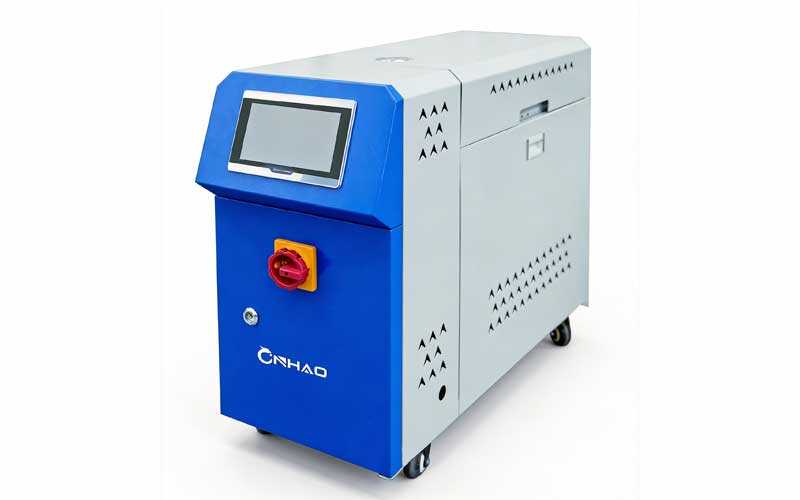
Where high mold temperatures are required — 80°C and up for PC, PPSU, or high-gloss surfaces — that heat comes from a регулятор температуры пресс-формы, not from the chiller. The two machines are complements, not substitutes, and sizing one without the other is how plants end up with a chiller fighting a heater.
Central Plant or One Chiller Per Machine?
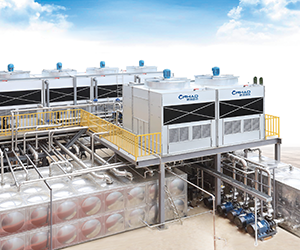
Both work, and the decision is mostly about duty diversity and maintenance philosophy rather than efficiency slogans. Central plants win on part-load efficiency and serviceability; individual units win on isolation — one failure doesn’t stop twelve presses. We covered the trade-offs, buffer tank sizing, and piping layout in the центральная холодильная установка guide.
Whichever way you go, the same four numbers still decide it — temperature, flow, head, and circuit count. A water chiller for injection molding is judged by what arrives at the mold, not by what leaves the machine room.
The question that matters for the chiller itself: does your selected unit hold its efficiency at 30% load? Plants rarely run flat out, so part-load COP is usually worth more than peak COP.
Air-Cooled or Water-Cooled?
For this application the choice is mostly climatic and infrastructural. Air-cooled units are self-contained and simple but lose capacity on hot days — exactly when you need it. Water-cooled units hold capacity better and run quieter, but they need a condenser water loop and a heat rejection path, which usually means a cooling tower and water treatment.
If your ambient regularly exceeds 35°C, or the chiller sits in a closed room with poor ventilation, air-cooled capacity derating will bite you. The detailed comparison, including derating curves and water consumption, is in our guide to air-cooled vs. water-cooled chillers.
Water Quality and Winter: The Two Things That Kill Chillers
Neither appears on a quotation, and both cause more downtime than compressor failures.
- Scale. Half a millimetre of scale in a mold channel can cut heat transfer by 20–30%. Symptoms look exactly like an undersized chiller, so plants buy a bigger machine instead of cleaning the circuit.
- Biological growth. Warm return water plus an open tower is an algae farm. It blocks strainers and fouls plates.
- Freezing. Any outdoor piping, tower basin, or idle unit needs draining or glycol. Freeze damage to a plate exchanger is a multi-day stoppage, and it happens in “warm” climates too.
- Corrosion. Mixed metals in one loop — copper, steel, aluminium molds — will galvanically attack the least noble one. Inhibitor dosing is cheap; a new manifold isn’t.
Minimum program: strainers on the return, a side-stream filter, inhibitor dosing, quarterly conductivity checks, and a written winter shutdown procedure.
Seven Specification Mistakes We See Repeatedly
These show up in enquiries for a water chiller for injection molding far more often than any genuine technical misunderstanding:
- Sizing by machine tonnage instead of heat load
- Specifying kW and never specifying flow and head
- Putting the feed throat on the mold circuit
- Daisy-chaining six molds on one line so the last tool gets whatever is left
- Setpoint at 7°C “to be safe,” then fighting condensation all summer
- No insulation on chilled lines running through a humid plant — the pipe drips, and the drip lands on parts
- No buffer tank, so the compressor short-cycles on small loads and the setpoint oscillates
What to Put in Your Enquiry
If you send this list to a supplier, you’ll get a comparable quote and a machine that works:
- Number of machines, shot mass and material per machine, cycle time
- Required supply temperature per circuit, and design ΔT (5 K is typical)
- Calculated heat load in kW, with your safety margin stated separately (10–20% is reasonable; 50% means the load wasn’t calculated)
- Required flow in m³/h and required pump head in m, including the longest pipe run
- Ambient conditions: max summer temperature and humidity — humidity drives the dew point limit on setpoint
- Whether a холодильная установка с водяным охлаждением with tower is feasible, or an industrial air-cooled chiller is required
- Water quality available on site and whether you’ll run treatment
- Winter shutdown plan, including glycol if any piping is outdoors
Часто задаваемые вопросы
What temperature should chilled water be for injection molding?
For general mold cooling, 25–30°C is usually correct. Technical parts often want 18–22°C, and optical or high-gloss work may need 10–16°C. Whatever you choose, keep it at least 2–3 K above your plant’s worst-case dew point or the mold will condense water.
Do I still need a chiller if I have a cooling tower?
Yes, if you need water below ambient wet-bulb capability. A tower gets you to roughly 28–32°C in most climates. Controlled 20°C water, or anything below ambient, requires a chiller. The tower then serves the chiller’s condenser.
Can one chiller serve several injection molding machines?
Yes, and it is usually more efficient — machines rarely peak simultaneously. Size the plant on diversified load, not the sum of nameplates, and make sure the pump head covers the furthest machine.
How do I stop my mold from sweating?
Raise the water setpoint above the ambient dew point, dry the air around the tool if the room is very humid, and insulate chilled piping. Condensation is a dew point problem, not a chiller capacity problem — buying a bigger machine makes it worse.
Air-cooled or water-cooled for an injection molding plant?
Air-cooled is simpler and needs no tower water treatment, but derates in high ambient temperatures. Water-cooled holds capacity better in hot climates and runs quieter, at the cost of a condenser loop and a tower. Hot climates and high duty cycles favour water-cooled.
What size chiller do I need for a 200-ton machine?
Tonnage alone can’t answer it. You need shot mass, material, and cycle time — a 200-ton press can represent anywhere from 3 kW to 15 kW of cooling duty. Our chiller sizing guide walks through the calculation with worked examples.
Итог
Specify a water chiller for injection molding by heat load, target temperature, flow, and pump head — in that order. Set the temperature from the process and the dew point, not from habit. Zone the circuits so the feed throat and hydraulics stop borrowing the mold’s water. Then spend the remaining budget on water treatment, because a scaled-up circuit makes every chiller look undersized.
Chillers are only one part of the cooling picture. For the full equipment landscape, see our plastic auxiliary equipment guide.