





PET Crystallization & Drying Line: Sizing, Energy & Costs

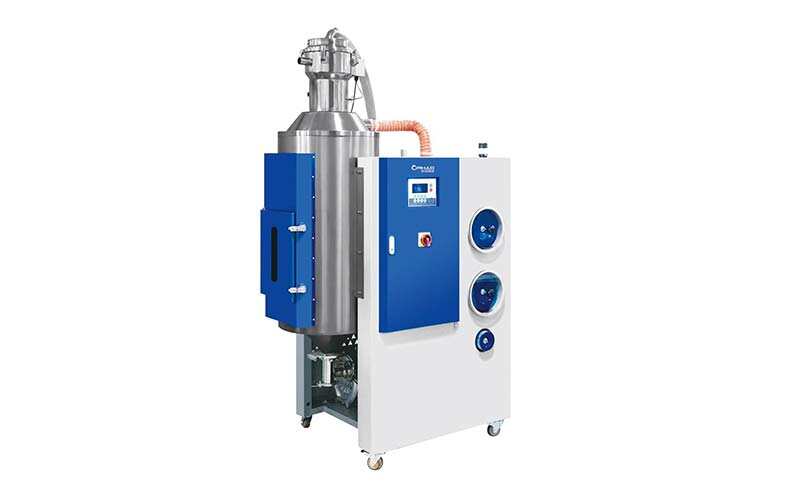
A brand new dehumidifying dryer arrives on a pallet. Its dew point gauge reads −40 °C. Three weeks later the preform line is still fighting haze, black specks, and random IV drops. It usually looks like one of these:
- Scenario 1. A 48-cavity preform cell runs at 600 kg/h. The dryer was bought “for 600 kg/h.” Two months in, every Monday start-up makes two hours of hazy preforms. Nobody touched the settings — the line just started blending 25% regrind, and nobody sized the hopper for regrind bulk density.
- Scenario 2. A PET sheet line gets a new die and output goes from 400 to 520 kg/h. Rather than buy capacity, the process tech raises drying temperature from 165 to 180 °C to “dry faster.” The haze stops — and the sheet starts yellowing, with IV dropping enough that thermoforming scrap triples.
- Scenario 3. A converter starts running 30% rPET flake. At 3 a.m. the material bridges and fuses into a plug in the hopper cone, and the line loses six hours to a jackhammer and a lot of swearing.
Every one of those gets reported as “the dryer is bad.” In our experience auditing PET lines, fewer than half actually are. The dryer is one node in a chain, and a PET line is only as good as its weakest node.
The dryer is rarely the problem — the line is
PET is the least forgiving commodity resin you will run. Residual moisture above roughly 0.005% (50 ppm) at melt temperature hydrolyzes the polymer chain, dropping intrinsic viscosity (IV) and raising acetaldehyde. Once the chain is cut, no downstream tweak puts it back. Your drying system is protecting the molecular weight you paid for.
Drying is also the slowest step in a PET plant, which makes it where every upstream compromise lands. A crystallizer that cannot keep pace feeds amorphous material that bridges. Oversized conveying elutriates fines that coat the desiccant. A cold machine throat lets dried pellets re-adsorb moisture on the way in. A bigger dryer fixes none of those.
So spec the line, not the machine. Here is the framework — arithmetic included.
The five nodes of a PET crystallization and drying line
| Node | What it actually controls | Practical PET target | How it shows up when undersized |
|---|---|---|---|
| 1. Crystallizer | Raises pellet crystallinity so material survives 160–180 °C in the hopper without fusing | 25–35% crystallinity before the drying hopper; 8–12 min (IR) or 25–40 min (hot air) | Bridging, rat-holing, fused plugs, uneven residence time |
| 2. Drying hopper | Residence time at temperature — the actual mechanism of moisture removal | 4–6 h usable residence at full line rate; material at 160–175 °C | Moisture spikes at start-up, wet material after rate changes |
| 3. Process air / desiccant wheel | Driving force: how dry the air entering the hopper is | Dew point ≤ −40 °C measured at the hopper inlet, not the dryer outlet | Drying takes longer and longer, “the desiccant must be tired” |
| 4. Conveying to throat | Moisture re-adsorption and fines generation between dryer and machine | Insulated/hot conveying; arrival temperature ≥ 130 °C; no streamers | Good material leaving the dryer, wet parts coming off the tool |
| 5. Reclaim loop | Bulk density, dust, and blend ratio stability | Grind sized to match virgin pellet; <1% fines; metered (not hand-scooped) blend | Wild swings in bulk density, hopper level hunting, IV variation part to part |
Two honest notes: nodes 1, 4, and 5 are where most plants lose money, and they are the cheapest to fix. And if you run rPET flake rather than virgin pellet, treat every row as a different machine.
Sizing the line: three numbers that actually matter
1. Usable hopper volume, not catalog rating
The relationship is simple and it is the single most useful piece of arithmetic in this whole article:
Vusable (L) = Q (kg/h) × t (h) ÷ ρbulk (kg/L)
Vspecified = Vusable ÷ usable factor (0.75–0.82 for a cone-bottom hopper)
That usable factor is what vendors quietly skip. A hopper labeled 5,000 L holds that to the lid; the level sensor has a deadband, the cone below the discharge does not drain, and you never truly run it full. Budget for losing 18–25%.
Bulk density is the other trap:
- Crystallized PET pellet: 0.75–0.85 kg/L
- Amorphous PET pellet: 0.40–0.50 kg/L
- PET regrind: 0.45–0.60 kg/L
- rPET flake: 0.25–0.40 kg/L
Worked example. A 600 kg/h preform line, 5-hour residence target, crystallized virgin pellet at 0.75 kg/L:
Vusable = 600 × 5 ÷ 0.75 = 4,000 L
Vspecified = 4,000 ÷ 0.78 = 5,130 L → spec a 6,000 L hopper.
Now add the reclaim loop most plants have. At a 30% regrind blend, effective bulk density drops to roughly 0.60 kg/L. The same “600 kg/h” dryer, if it was bought by catalog rating alone at crystal pellet density, delivers:
t = Vspecified × 0.78 × 0.60 ÷ 600 ≈ 3.1 hours — not five.
Nobody changed the machine. The material changed, and three hours of residence at any dew point will not reach 50 ppm. That is Scenario 1.
2. Airflow and where you measure dew point
Process heater power follows: P (kW) = V̇ (m³/h) × 1.2 × 1.005 × ΔT (K) ÷ 3,600. For 2,500 m³/h going from 25 °C ambient to 170 °C process, P ≈ 121 kW. Add regeneration heaters, blowers, and controls at roughly +25% and you are near 152 kW connected.
Where you measure matters more than the number. A probe on the dryer outlet reads the driest air the machine ever makes. A probe at the hopper inlet reads what your resin sees, after duct losses and return-air mixing. We have measured 8 °C of dew point degradation between those two points on a poorly insulated line. If you own one probe, put it at the hopper inlet.
3. Crystallization capacity vs. line rate
Crystallization is what everyone under-buys, because no part drawing asks for it. It has physical consequences instead: PET must reach roughly 25–35% crystallinity or it softens and fuses at drying temperature, and once it fuses you have a maintenance problem rather than a process problem. Size throughput to your peak line rate plus reclaim return, with 15–20% headroom. On flake, size on its lower bulk density and expect longer residence.
What a PET line actually costs to run
Here is the comparison we build for customers choosing between a legacy line and an upgraded one. Same 600 kg/h cell, 8,000 h/year, electricity at $0.10/kWh, resin at $1,050/t.
| Legacy line hot-air crystallizer + standard desiccant dryer |
Upgraded line IR crystallizer + heat-recovery dryer |
|
|---|---|---|
| Specific energy consumption | 0.42 kWh/kg | 0.28 kWh/kg |
| Annual energy at 4,800 t | 2,016,000 kWh — $201,600 | 1,344,000 kWh — $134,400 |
| Residence time control | ±45 min swing on ambient changes | ±10 min |
| Haze / IV reject rate | 2.1% observed | 0.6% expected |
| Scrap cost @ $1,050/t | $105,840 | $30,240 |
| Total annual cost | $307,440 | $164,640 |
The delta is about $143,000 per year against an equipment delta of $150,000–$220,000 — roughly 13–19 months’ payback, deliberately conservative. Sanity-check it yourself: monthly drying kWh divided by monthly kilograms processed. Anything above 0.45 kWh/kg deserves more attention than your next resin negotiation.
When the cheap, simple setup is genuinely the right answer
We sell integrated lines, so let us be clear about when you should not buy one. A standalone hopper dryer is often correct:
- Throughput below roughly 80–120 kg/h. Below that, an IR crystallizer plus heat recovery will not pay for itself.
- You buy pre-crystallized PET. If resin arrives at 30%+ crystallinity and stays sealed, someone else already ran node 1. Do not duplicate it.
- PETG and some copolyesters. PETG does not crystallize and dries at 60–70 °C over a longer cycle. Crystallizing it is not extra insurance, it is a mistake.
- Job shops with frequent material changes. If you change product three times a week, flexibility beats 0.14 kWh/kg.
- Capital is expensive and power is cheap. At $0.04/kWh the energy case shrinks 60% and payback stretches past four years.
- Pilot, R&D, and sample lines. Buy the standalone machine, learn the process, then specify the line.
There is also a middle path: keep your dryer and add a dedicated crystallizer, or a second small hopper purely to extend residence. We quote that when it is the honest answer.
Nine mistakes that reliably cost PET processors money
- Sizing on virgin bulk density, then feeding regrind or flake. The most common error here.
- Ignoring usable hopper volume. Catalog liters are not residence-time liters. Subtract 18–25%.
- Measuring dew point at the dryer outlet. Measure at the hopper inlet, where it counts.
- Raising temperature to compensate for short residence time. You dry faster and degrade more. Cap yourself at 0.02–0.03 dL/g IV loss.
- Skipping fines removal on regrind. Fines coat desiccant and cause localized overheating. Grind to match virgin pellet size, then screen it.
- Cold conveying runs. Uninsulated pipe drops material below 130 °C and it re-adsorbs moisture on the way to the throat.
- Hand-scooping reclaim. Hand blending makes every downstream node chase a moving target. A metered central feeding system stabilizes it.
- Never re-verifying the desiccant bed. Wheel efficiency drops with age and contamination. Check annually; most plants never do.
- Buying on price per machine instead of cost per good part. A dryer that is $6,000 cheaper and 15% less efficient costs about $30,000 more over five years.
What to send your equipment supplier
The quality of a quote is set almost entirely by this list. Send it before you ask for a price:
- Peak and average throughput in kg/h, including reclaim return rate
- Material form: virgin pellet, amorphous, pre-crystallized, regrind %, flake %
- Measured bulk density of your actual blend, not a datasheet
- Incoming moisture and target — typically ≤50 ppm, tighter for medical or barrier work
- Specified residence time and maximum allowed IV drop
- Floor area, ceiling height, and whether the machine room is climate controlled
- Electrical supply available, including spare amps
- Worst-case summer temperature and relative humidity at your site
- Whether the line runs unattended nights and weekends
- Your energy cost per kWh — this decides whether heat recovery pays back in 14 months or never
Frequently asked questions
Do I always need a crystallizer for PET?
No. If your PET arrives pre-crystallized from the producer, stays sealed, and goes straight into the hopper, you can often skip it. If you feed amorphous virgin pellet, regrind, or flake — especially above about 20% reclaim — you need crystallization sized to your peak rate. Our guide to choosing a PET drying system covers the dew point and residence side in more depth.
Can I dry PET longer at a lower temperature instead?
In practice, no. Below roughly 150 °C moisture diffusion slows so much that drying time becomes impractical. Control the outcome with residence time and dew point, not temperature.
What dew point do I actually need?
−40 °C (−40 °F) at the hopper inlet is the working target for PET and what we specify. Distrust readings taken anywhere else in the circuit, and re-check quarterly that the desiccant wheel still delivers it.
How much rPET flake can I run without changing my line?
Most lines tolerate 10–20% flake before crystallization and conveying become limiting. Past that you need dedicated crystallization sized for flake’s lower bulk density plus fines removal, and conveying design usually needs revisiting too.
How much does an IR crystallizer really save versus hot air?
Directly, about 0.10–0.16 kWh/kg, mostly from cutting residence to 8–12 minutes and dropping a large hot-air loop. The bigger value is stability: less inventory of heat-damaged material and faster response to rate changes. Payback still depends entirely on your power price.
My moisture readings are fine but my preforms still haze. Why?
In order of frequency: IV degradation from excessive temperature or residence, re-contamination between dryer and throat, and under-crystallized material fusing into lumps so some pellets get far less drying than others. Check arrival temperature at the throat and IV shift before touching anything else.
Bottom line
A PET crystallization and drying line is not a dryer wearing a bigger hat. It is a chain — crystallize, dry, convey, feed, reclaim — and the limiting node sets your quality ceiling and energy bill. Sometimes the answer is a line; sometimes it is honestly an $8,000 second hopper.
We spec PET lines every week, including the ones we tell customers not to buy yet. Send the list above and we will run your numbers.
For a wider view of how drying fits alongside temperature control, conveying, and sizing across the whole plant, start with our complete guide to plastic auxiliary equipment, or read about how we approach turnkey plant equipment projects when the scope goes beyond a single machine.