






Plastic Dehumidifying Dryer: How to Choose the Right One

Plastic Dehumidifying Dryer: How to Choose the Right One
Nylon parts that come out brittle. PC lenses with silver streaks. PET preforms that lose impact strength for no reason you can trace. Nine times out of ten, the press isn’t the problem — the resin went into the barrel wet.
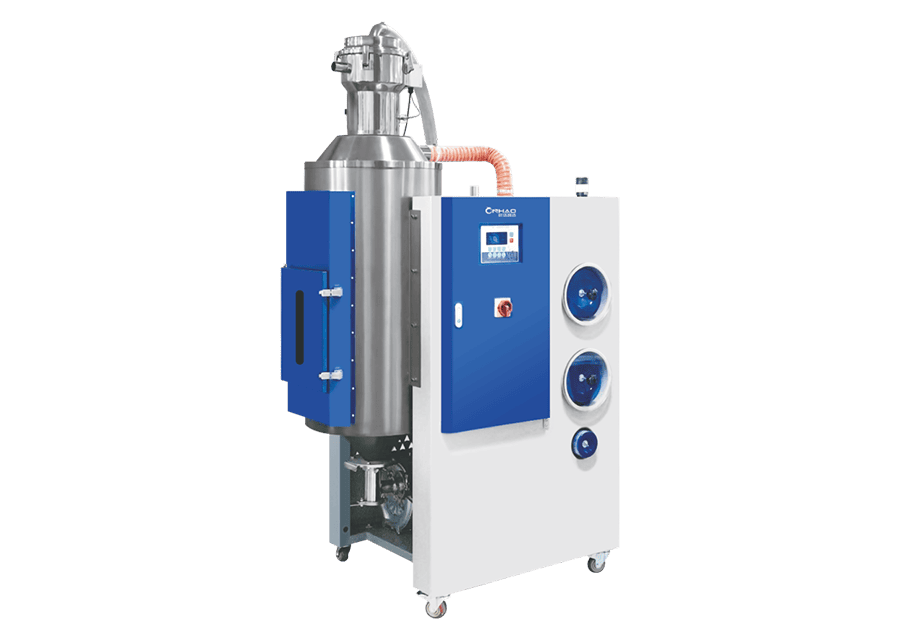
A plastic dehumidifying dryer exists to solve exactly this, and choosing one comes down to three numbers: the dew point you can hold, the airflow you actually need, and whether your hopper is big enough to give material the time it takes to dry. Get those right and hygroscopic resins stop being a gamble.
Why Some Plastics Can’t Be Dried With Hot Air
Most people assume drying is about heat. It isn’t — it’s about the moisture gradient between the air and the resin. Water moves out of the pellet and into the air only if the air is drier than the pellet. Hot air from the plant is usually not.
Hygroscopic resins chemically bind water:
- PA6 / PA66 (nylon) — absorbs moisture fast, and hydrolyzes at melt temperature, which permanently breaks polymer chains
- PET — same mechanism, and the damage shows up as lost intrinsic viscosity
- PC — moisture turns to steam in the barrel; you get splay, bubbles, and reduced strength
- PMMA, PBT, PSU — all need genuinely dry air, not just warm air
PE and PP are the exceptions — they’re non-hygroscopic, and surface moisture is usually handled without a dehumidifier at all.
Hot Air Dryer vs. Dehumidifying Dryer
This is the most common source of underspecified equipment:
| Característica | Hot air hopper dryer | Dehumidifying dryer |
|---|---|---|
| How it works | Heats ambient air and blows it through the hopper | Strips moisture from the air first, then heats it |
| Typical dew point | Ambient — often above 0°C | −20°C to −50°C |
| Drying driver | Temperature only | Low dew point plus temperature |
| Works for PE / PP | Yes | Yes, but overkill |
| Works for PA / PET / PC | No — will not reach equilibrium | Yes |
| Energy use | Inferior | Higher (regeneration heating) |
A hot air dryer running at 80°C with ambient air at 60% humidity simply cannot pull moisture out of nylon. Raising the temperature to compensate risks oxidizing or agglomerating the material before it dries. If you process hygroscopic resin, you need a plastic dehumidifying dryer — there’s no cheaper substitute.
Dew Point: The Number That Actually Matters
Dew point is the temperature at which water condenses out of air. Lower dew point means drier air, and drier air pulls moisture out of resin faster and further.
Practical targets by material:
| Material | Typical drying temp | Target dew point | Typical drying time |
|---|---|---|---|
| PA6 / PA66 | 80–90°C | −25 to −40°C | 4–6 h |
| PET (after crystallization) | 150–170°C | −40°C or lower | 4–6 h |
| PC | 120°C | −30 to −40°C | 3–4 h |
| PMMA | 80–90°C | −30°C | 3–4 h |
| ABS | 80–90°C | −20 to −30°C | 2–3 h |
Two things follow from this. First, a dryer that advertises “−40°C” must hold that number under load, at your airflow, with aged desiccant — not just on a cold start in the showroom. Second, you need to measure it. A dew point sensor at the hopper inlet is the difference between knowing your material is dry and assuming it is.
Sizing a Plastic Dehumidifying Dryer: Airflow
Airflow has to do two jobs: carry enough heat into the resin, and carry the released moisture away.
A workable starting point:
Required airflow (m³/hr) = throughput (kg/hr) × air demand per kg
Air demand per kilogram ranges roughly 1.8–2.5 m³/kg depending on resin and drying temperature — denser and higher-temperature materials sit at the upper end. Then add 20–30% margin for filter loading, duct losses, and desiccant aging.
Worked example: 120 kg/hr of PA66 at 2.2 m³/kg gives 264 m³/hr. With 25% margin, specify around 330 m³/hr.
Under-sizing airflow is the classic failure. The heater reaches setpoint, the display looks fine, and material still comes out wet — because there wasn’t enough air mass moving through to carry moisture out.
Hopper Sizing: Where Most Plants Get It Wrong
Airflow gets the attention; hopper capacity is where the actual mistakes happen. Material must spend enough time in the hopper to reach equilibrium:
Residence time (hr) = material in hopper (kg) ÷ throughput (kg/hr)
So:
Required hopper capacity (kg) = throughput (kg/hr) × drying time (hr)
If you’re running 120 kg/hr of PA66 with a 5-hour drying time, you need at least 600 kg of material in the hopper — and that’s usable capacity, not the nameplate volume. A hopper that’s only ever half full never delivers its rated residence time.
Two more points that bite in practice:
- Level matters. Below roughly a third full, air channels through the resin instead of flowing evenly through it, and drying becomes erratic.
- Refill cycles matter. Every time fresh wet material lands on top, it needs its full drying time before reaching the bottom. Continuous top-filling with insufficient capacity means wet material keeps arriving at the screw.
Properly sized, the hopper also needs to be fed reliably — a sistema integrado de carga por succión keeps level stable without the operator intervention that causes half-empty hoppers in the first place.
Desiccant Technologies Inside a Plastic Dehumidifying Dryer
Both remove moisture from process air; they differ in how they regenerate.
| Type | How it regenerates | Punto de rocío | Strengths |
|---|---|---|---|
| Twin-tower molecular sieve | Two beds alternating drying and regenerating | −40°C and below | Very low, stable dew point; handles high loads |
| Honeycomb rotor | Slowly rotating wheel, continuous regeneration sector | −30 to −40°C | Compact, no switching valves, steady output |
A dual molecular sieve dehumidifier is the safer choice when you need the lowest possible dew point or you’re running variable throughput. A deshumidificador rotativo de panal suits continuous, steady-duty lines where footprint and simplicity matter more. For compact cells feeding a single press, an deshumidificador rotativo integrado combines drying and conveying in one unit.
Temperature: Don’t Just Turn It Up
Higher temperature speeds drying, but there’s a ceiling:
- Too hot — oxidation, yellowing, pellets softening and bridging into a solid mass in the hopper
- Too cool — drying time stretches well beyond what your hopper provides
- Uneven — hot spots near the heater, cold zones at the wall, giving you a hopper that’s dry in the middle and wet at the edges
Run the manufacturer’s recommended temperature for the specific grade. If you’re fighting a moisture problem, fix dew point and residence time before reaching for the temperature dial.
Closed-Loop vs. Open-Loop
Closed-loop dryers recirculate process air through the desiccant bed rather than exhausting it. The payoff is real: regeneration energy drops, dew point stays stable when ambient humidity swings, and you’re not continuously heating fresh plant air.
Open-loop units cost less upfront and are sometimes adequate for mild-duty materials. For hygroscopic resins running year-round — especially in a humid climate — closed-loop pays for itself, and it’s the configuration I’d default to.
Why Material Still Comes Out Wet
| Symptom | Likely cause | Fix |
|---|---|---|
| Dew point won’t reach target | Exhausted desiccant, regeneration heater fault, or air leak in the loop | Check desiccant condition, heater, and all duct connections |
| Parts show splay despite good dew point | Residence time too short, or hopper running low | Increase usable hopper capacity; maintain level |
| Drying inconsistent batch to batch | Material channeling, uneven bed, or wet material added on top | Check air distribution, refill practice, and hopper level |
| Airflow drops over time | Clogged process filter or blocked ducting | Clean filters, inspect ducts on a schedule |
| Material discolored or clumped | Temperature too high, or material sitting too long | Lower setpoint; avoid overfilling during downtime |
Energy and Running Cost
Regeneration heating is the main ongoing cost. Three things reduce it without hurting drying:
- Insulate the hopper — cheap, immediate, and often skipped
- Recover heat from return air where the design allows it
- Don’t oversize — a dryer running at 30% load wastes regeneration energy every cycle
If you’re drying regrind alongside virgin, remember regrind has more surface area and picks up moisture faster. Material coming out of a granulador should go back into drying promptly rather than sitting open in a bin.
Maintenance That Protects Dew Point
- Daily — log dew point and hopper temperature; glance at filter condition
- Weekly — inspect process and return filters, check for air leaks at connections
- Monthly — verify regeneration heater operation and temperature, check valve sequencing on twin-tower units
- Annually or per hours — replace desiccant; its capacity fades long before it visibly fails
How to Choose: A Buyer’s Checklist
- List every resin you’ll dry — this sets dew point and temperature requirements
- Set a dew point target for the most demanding material, and confirm the unit holds it at your airflow
- Calculate airflow from throughput × air demand, then add 20–30% margin
- Size the hopper from throughput × drying time, and treat that as usable capacity
- Choose desiccant type: twin-tower for lowest dew point, rotor for compact continuous duty
- Specify closed-loop unless the duty is genuinely light
- Insist on a dew point sensor at the hopper inlet — not just on the dryer cabinet
- Confirm filter access, desiccant replacement interval, and spare parts lead time
Frequently Asked Questions
What dew point do I need?
It depends on the resin. Nylon typically wants −25 to −40°C, PET −40°C or below, PC around −30 to −40°C, and ABS −20 to −30°C. Specify for your most demanding material, and measure at the hopper inlet rather than trusting the cabinet readout.
Can I use a hot air dryer instead?
Only for non-hygroscopic resins like PE and PP. For nylon, PET, PC, and similar materials, hot air cannot reach a low enough moisture level regardless of temperature — you need dehumidified air.
How do I know if my hopper is too small?
Compare residence time against the resin’s required drying time. Divide the mass of material actually in the hopper by your hourly throughput; if that’s less than the drying time, the hopper is undersized for the job.
Why is my dew point good but parts still have splay?
Usually residence time or hopper level. Material may not be spending long enough in the hopper, or the level is dropping low enough that air channels through instead of flowing evenly. Check level practice before adjusting anything else.
Should I choose a molecular sieve or a honeycomb rotor?
Twin-tower molecular sieve reaches and holds the lowest dew points and handles variable loads well. Honeycomb rotors are compact, run continuously without switching valves, and suit steady-duty lines. Choose based on dew point requirement first, footprint second.
Where to Go Next
Drying doesn’t sit in isolation, and a plastic dehumidifying dryer is only as good as the material flow around it. Material arriving from storage needs reliable conveying, and where you dry relative to the press is a plant-level decision with real trade-offs — our guide to central versus machine-side dehumidifying dryers covers that choice in detail.
If PET is your main material, the crystallization step changes the whole drying calculation, and our PET drying system guide walks through it. For regrind and additives, keep the blend consistent before it reaches the hopper — a máquina de mezcla de colores en seco handles that stage.