


Robot para moldeo por inyección: cómo elegir el más adecuado

Robot para moldeo por inyección: cómo elegir el más adecuado
The night shift tells the story first. Day shift runs a clean 14.2-second cycle; night shift drifts to 15.8 because parts stick, operators pull them a beat late, and every so often a part drops back into the mold and costs a re-grind or a damaged cavity. Nothing is “broken” — the human in the loop is simply variable, and variability is what eats output.
That is the real job of an injection molding robot: not to be faster than a person, but to be identical, cycle after cycle, shift after shift. Choosing one comes down to four numbers — payload, reach, take-out time, and what hangs on the end of the arm. Get those right and the robot disappears into the rhythm of the press. Get them wrong and you own an expensive machine that parks itself in the corner.
Consistency Is What You’re Actually Buying
A robot rarely shortens the theoretical cycle — cooling time does that. What it removes is variance: the half-second here, the stuck part there, the occasional double-shot because someone pulled a part late and the mold closed on the runner. Across a 24-hour day, removing that noise is typically worth more than any single second shaved off the timer.
The second thing it buys is safety. Every manual part pull is an operator reaching between platens. A robot moves people out of the mold area and into supervision — which is also the only way a plant ever runs unattended hours. If lights-out production is on your roadmap, part extraction is one link in the chain; the full sequence is covered in our Guía de automatización del moldeo por inyección.
The Three Main Types of Take-Out Robots
Almost every injection molding robot on a shop floor belongs to one of three families:
1. Sprue pickers and swing-arm robots
The entry point. Small pneumatic or servo arms that reach in, grab the sprue or a small part, and swing it out to the side. Payload is usually under 2 kg, take-out can be under a second, and the price is low enough that even a single-cavity job justifies one. The limitation is obvious: they pick, they don’t place. If you need the part oriented, stacked, or set on a conveyor, a picker is not enough.
2. Cartesian (traverse) robots — including bullhead manipulators
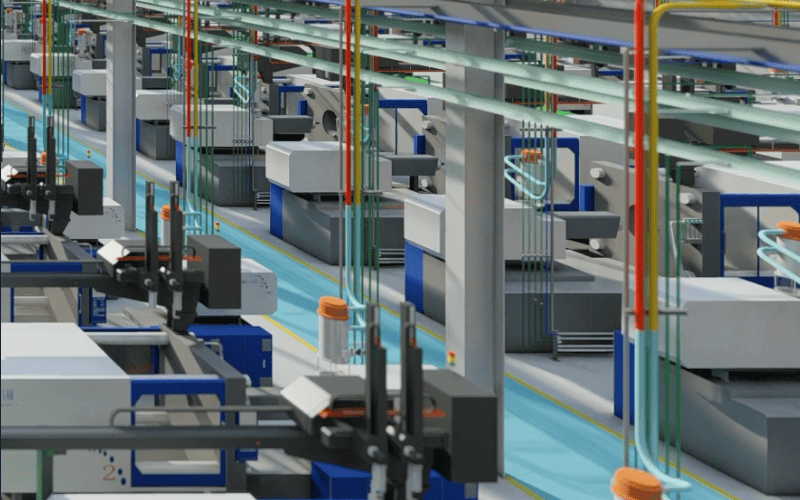
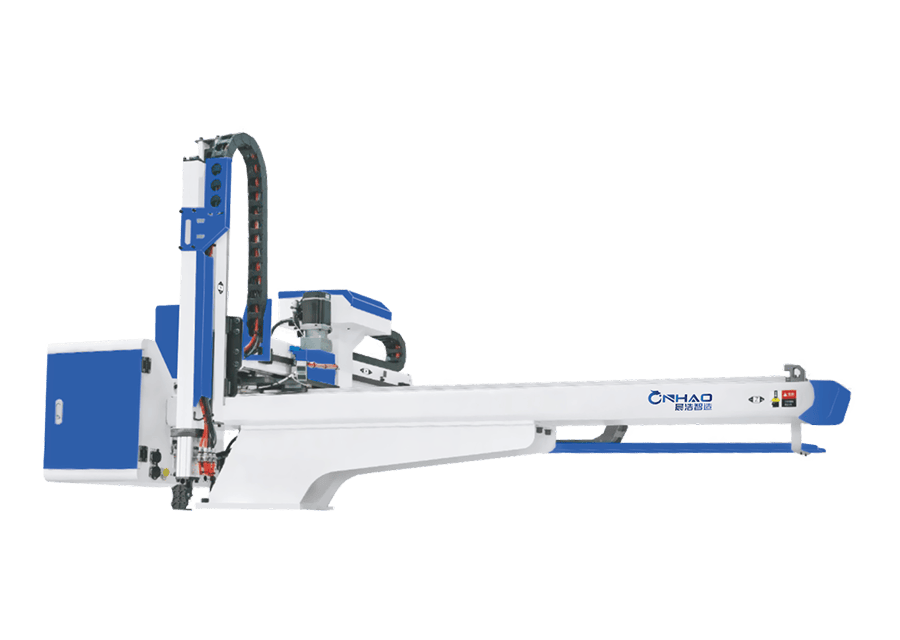
The workhorse. A horizontal beam spans the mold area, a vertical arm descends between the platens, and the whole carriage travels along the beam to a drop position beside or behind the press. Servo-driven traverse units handle payloads from a couple of kilograms to 50 kg and beyond, with take-out times around 0.8–2 seconds on small parts. The open-frame “bullhead” layout — like our Bullhead Manipulator series — keeps the structure rigid while staying compact enough for low-ceiling shops, which is why this style dominates on machines from roughly 50 to 650 tons.
3. Six-axis articulated robots
The flexible option. An articulated arm on the floor beside the press can do what a traverse unit cannot: insert loading before the shot, degating, in-mold labeling, assembly, inspection, and box packing after it. The trade-offs are floor space, guarding, and price — and a slower raw take-out than a dedicated traverse arm. Choose six-axis when the value is in the operations around the molding, not the extraction itself.
| Type | Typical payload | Take-out time | Ideal para | Budget band |
|---|---|---|---|---|
| Sprue picker / swing-arm | < 2 kg | 0.6–1.0 s | Sprue removal, tiny parts, simple jobs | Low |
| Cartesian / traverse (bullhead) | 2–50+ kg | 0.8–2.0 s | Reliable take-out + placing on 50–650 T presses | Mid |
| Six-axis articulated | 3–80+ kg | 2–5 s | Insert loading, post-mold operations, flexible cells | High |
Sizing an Injection Molding Robot to Your Press
Catalogs size robots by machine tonnage because it’s convenient — but tonnage is a proxy, not a spec. When you size an injection molding robot properly, three numbers decide it:
Payload. Add up everything the wrist carries: part + runner/sprue + the gripper itself, then multiply by a safety factor of 1.5–2. The mistake everyone makes once is weighing the part and forgetting the EOAT. A gripper plate with four vacuum cups, fittings, and a sensor can easily weigh 3 kg — on a 5 kg-rated arm, that alone eats most of the margin.
Reach and stroke. The vertical stroke must cover the mold open daylight, plus the part height, plus clearance to lift the part free of cores and lifters. The traverse stroke must carry the part from the mold centerline to wherever it gets released — conveyor, chute, or fixture — without the beam colliding with the ceiling crane or the dryer above the feed throat. Measure the building, not just the press.
Interface. Before anything else, confirm the press can talk to a robot: a Euromap 67 (or older Euromap 12) connector, or at minimum potential-free contacts for mold-open, ejector position, and safety gate. Most modern machines have it; older presses may need an interface relay box.
| Machine size | Typical shot weight (PS) | Robot class | Rated payload |
|---|---|---|---|
| 50–150 T | up to ~250 g | Sprue picker / small traverse | 2–5 kg |
| 150–350 T | ~250 g–1 kg | Traverse, single or dual arm | 5–10 kg |
| 350–650 T | ~1–2.5 kg | Bullhead / heavy traverse | 10–25 kg |
| 650–1300 T | ~2.5–8 kg | Heavy traverse, telescopic vertical | 25–50 kg |
| > 1300 T | 8 kg+ | Extra-heavy traverse or gantry | 50 kg+ |
Use this table as a starting filter, then run the payload and stroke math on your actual heaviest mold — including the runner, especially on three-plate tools where the runner system can weigh more than the part.
Take-Out Time Is a Budget, Not a Bragging Number
Every take-out borrows time from the cycle: the mold must be open and waiting while the arm comes in, grips, and clears the parting line. On a 15-second cycle, a take-out that adds 1 second of mold-open dwell costs about 6–7% of daily output. On a 40-second cycle, the same second costs 2.5%.
Two practical consequences:
- Thin-wall, fast-cycling parts (packaging, caps, containers) justify servo traverse units with sub-second entry — this is where take-out speed genuinely pays.
- Slow technical parts care more about gentle, repeatable handling than raw speed. Overspecifying a high-speed arm for a 45-second cycle is money spent on a number in a brochure.
The Gripper Matters More Than the Robot
Ask any automation engineer where take-out projects fail and the answer is almost never the arm — it’s the end-of-arm tooling. EOAT decides whether the part comes out cleanly, releases cleanly, and arrives undamaged:
- Vacuum cups for flat, smooth parts — check that textured or ribbed surfaces still seal
- Finger grippers for parts with a grip feature — sprues, bosses, edge flanges
- Sprue clamps dedicated to the runner so parts can be released separately from scrap
- Part-present sensors so the press knows the cavity is clear before it closes — the cheapest mold protection you will ever buy
Standardize on a quick-change chuck if the press runs multiple molds. EOAT changeover measured in minutes instead of an hour is what makes one robot serve a real production schedule instead of one dedicated job.
Integration: What Has to Sit Around the Robot
The robot is one cell component. The cell only works when the upstream and downstream equipment is planned with it:
- Upstream: material has to arrive at the throat without a human — a cargador de vacío de plástico on the hopper, or a central feeding system supplying the whole line
- Downstream: a conveyor under the drop position, a box-change or stacking routine, and somewhere for the sprue to go — usually a heavy-duty crusher beside the press so regrind goes straight back into the process
- Safety: interlocked guarding around the robot’s working envelope, and the robot’s safety circuits wired into the press’s mold-protection interlocks
Plan the floor layout before purchase, not during installation. The day the robot arrives is a bad day to discover the conveyor doesn’t fit between the press and the wall.
Payback Math: What the Spreadsheet Actually Looks Like
An injection molding robot pays for itself through labor reallocation, variance removal, and scrap reduction — in that order for most plants. The honest formula:
Payback (months) = installed cost ÷ monthly saving
Installed cost means robot + EOAT + conveyor + guarding + integration. Monthly saving is usually dominated by the operator hours released per shift, multiplied by the number of shifts:
| Scenario | Installed cost | Monthly saving | Payback |
|---|---|---|---|
| Sprue picker on one press, 2 shifts | $4,000–8,000 | ~$500–900 | 6–12 months |
| Servo traverse cell, 2–3 shifts | $18,000–35,000 | ~$1,400–2,200 | 12–18 months |
| Six-axis cell with post-mold ops | $40,000–70,000 | ~$2,500–4,000 | 15–24 months |
Scrap and consistency gains rarely appear in the pitch deck, but plants that track them usually find the true payback comes in a few months shorter than the labor math alone. The hidden return is capacity: variance removed from the cycle is output you already own, unlocked without buying another press.
Six Mistakes When Buying an Injection Molding Robot
- Buying by machine tonnage alone. Tonnage is a filter, not a spec — run the payload and stroke math on the heaviest actual mold.
- Forgetting the EOAT weight. The gripper counts against payload. Weigh it, don’t guess it.
- Ignoring the runner weight. On three-plate and hot-runner-with-cold-drop molds, the sprue system can outweigh the part.
- No stroke margin for the next mold. A robot bought exactly to today’s part is obsolete the day a taller part arrives. Leave 20–30% headroom in payload and stroke.
- Skipping the interface check. Confirm Euromap 67/12 or an interface relay plan for every press the robot will serve — before the order, not after delivery.
- No guarding or downstream plan. An unguarded robot and a part dropped on the floor is automation that creates work instead of removing it.
FAQ
How much does an injection molding robot cost?
As a rough installed range: sprue pickers run $3,000–8,000, servo traverse robots $10,000–30,000 depending on size and strokes, and six-axis cells $25,000–60,000 and up — plus $1,000–5,000 of EOAT per mold family. The press interface, conveyor, and guarding belong in the same budget line.
Will a robot shorten my cycle time?
Usually not the theoretical cycle — cooling time sets that. What a robot removes is variance: late pulls, stuck parts, door-open dwell. The output gain comes from every cycle running at the designed time instead of the average time.
What size robot do I need for my press?
Payload: (part + runner + EOAT weight) × 1.5–2. Stroke: mold daylight + part height + clearance, and enough traverse to reach the drop position. Then check the press interface. Tonnage tables are only a first filter.
Cartesian or six-axis — which one?
Pure take-out and placement on one press: cartesian/traverse, almost always — faster entry, lower cost, simpler guarding. Insert loading, degating, assembly, or packing after the shot: six-axis earns its floor space.
Can a robot run with an older press that has no Euromap connector?
Yes, in most cases — through an interface relay box that reads mold-open, ejector, and gate signals as potential-free contacts. It adds integration cost and limits some handshaking, so verify the specific press before committing.
Does a robot mean we need no operator?
It means the operator stops reaching into the mold. Someone still supervises multiple cells, changes EOAT between jobs, checks quality, and handles exceptions. Most plants redeploy one operator across three to five automated presses rather than eliminating the role.
The Bottom Line
Choose the robot by payload, reach, take-out budget, and the gripper — not by tonnage on a brochure. Plan the cell around it: material in, parts and sprues out, guarding closed. Do that, and an injection molding robot stops being a machine you bought and becomes the reason the whole line runs the same on Saturday night as it does on Tuesday morning.
If you’re mapping out part extraction for a line, start with our Bullhead Manipulator series for servo traverse take-out, and the plastic auxiliary equipment guide for everything that has to work around it.