




Central vs Machine-Side Dosing & Blending: How to Choose

A plant with 14 presses running two colors buys 14 machine-side blenders, one per machine. Fourteen sets of load cells to calibrate every week, fourteen hoppers to clean at every compound change, fourteen firmware menus to train people on. They spent $91,000 to solve a problem a $68,000 central system would have handled with a quarter of the maintenance hours.
Another plant runs 9 presses across 40 compounds. They went central because a supplier told them central is the professional choice. Now every color change means purging 60 meters of conveying line — 35 minutes, six times a day. They are giving away three and a half hours of press time daily to a decision that was made on the wrong criterion.
A third plant went central and then found out their mezzanine gives them 4.2 m of clearance. The blending unit needs 5.5 m. The structural work cost $22,000 on top of the equipment.
All three made the same mistake: they picked a configuration before asking the questions that actually determine the answer. Central vs machine-side dosing is not a question of which technology is better. It is a function of four numbers specific to your plant, and this article walks through all four with the cost math.
What the Two Configurations Actually Are
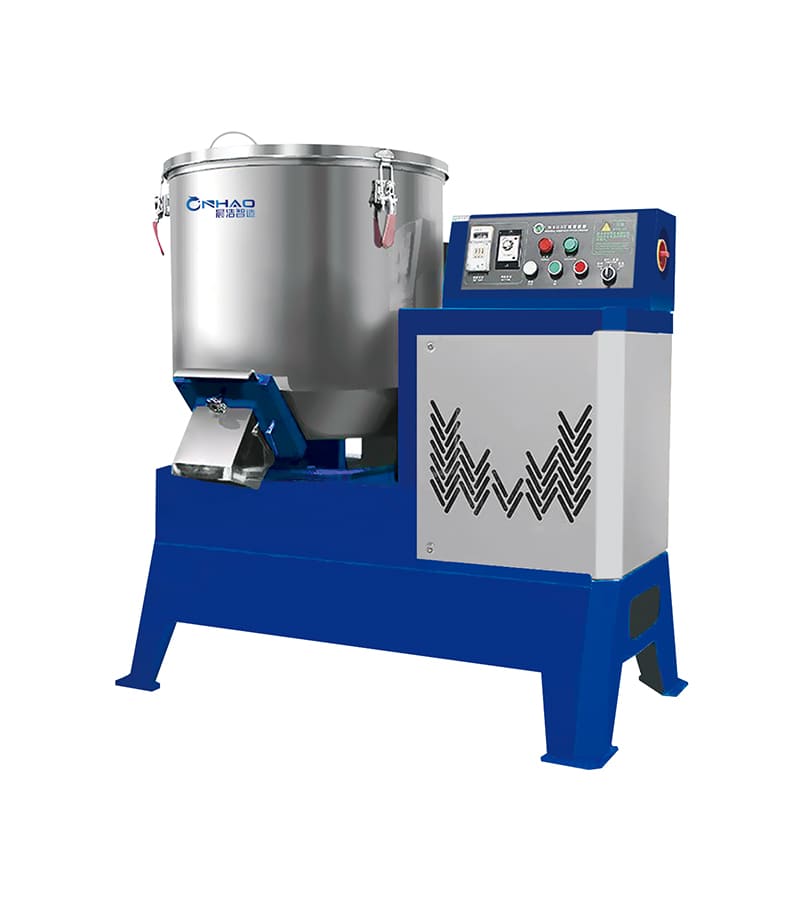
Machine-side dosing puts one blender on each press, mounted on the machine throat. Virgin material, regrind, colorant and any additive are metered and mixed right there, and the blend drops straight into the screw. Each press is its own closed loop.
Central dosing puts one or two large blending units in a central room or on a mezzanine. Each component is metered there, the blend is made in one place, and it is pneumatically conveyed through a distribution network to day hoppers or directly to the press throats.
The distinction sounds like a plumbing decision. It is really a decision about where you accept your risk.
Central dosing concentrates your risk in one machine and one control system. Machine-side distributes it across N blenders — but a central blender failing stops every press downstream of it, while a machine-side blender failing stops exactly one press. Which of those is worse depends entirely on how many presses you have and how interchangeable your orders are.
The Four Numbers That Decide It
Before anyone shows you a quote, get these four figures on paper. Everything else is detail.
1. Press count
This sets the capital crossover. Machine-side cost scales linearly — one blender per press, one controller per press, one calibration per press. Central cost is largely fixed: the blending unit, the distribution manifold, and the controls cost roughly the same whether you serve 8 presses or 20.
Below about 8–10 presses, machine-side is usually cheaper on capital. Above 12, central often pulls ahead, and the gap widens with every press you add.
2. Distinct recipes per week
This is the one most people skip, and it is the one that most often reverses the answer.
A recipe is a distinct combination of virgin grade, regrind ratio, colorant and additive package. If you run 40 of these a week, a central system means 40 purges of a long conveying line — or worse, cross-contamination carried in the line from the previous run. If you run three recipes a week, that problem barely exists.
3. Changeovers per press per day
Closely related, but not the same. Changeover frequency determines how much purge time you lose, and purge time is the hidden cost that kills central systems in high-mix plants.
4. Additive cost per kg
This sets the value of accuracy. If your additive is calcium carbonate filler at $0.40/kg, a 4% over-dosing error costs you almost nothing. If it is a UV stabilizer package at $18/kg, or a flame-retardant masterbatch at $9/kg, the same percentage error is a line item you will notice at the end of the year.
These four numbers sit on two axes: mix complexity (recipes + changeovers) pushes toward machine-side; scale and additive cost (presses + $/kg) push toward central. Most plants land clearly on one side once they write the numbers down.
Head-to-Head Comparison
| Factor | Machine-Side Dosing | Central Dosing |
|---|---|---|
| Capital cost | Scales per press; cheaper under ~10 presses | Mostly fixed; cheaper above ~12 presses |
| Dosing accuracy | ±0.5–1.0% (gravimetric), ±3–5% (volumetric) | ±0.3–0.5% typical, larger batch = better averaging |
| Color change time | 5–10 min (empty a small hopper) | 20–45 min (purge conveying line + unit) |
| Recipe flexibility | Every press can run a different recipe simultaneously | Limited by number of blend lines and purge discipline |
| Floor space at press | Blender + loader on every machine | Clear machine area; space needed in one central room |
| Headroom requirement | Fits above standard press throat | Usually needs 5–6 m in a dedicated area |
| Calibration workload | N blenders × weekly check | 1–2 units × weekly check |
| Failure impact | One press down | All downstream presses down |
| Regrind handling | Easy to vary per press | Needs separate regrind line or dedicated silo |
| Expansion | Buy another blender | Add a line to the manifold (cheaper per press) |
The Money: Two Worked Examples
Generic payback claims are useless. Here are two plants with the same press count and opposite answers.
Case 1 — 12 presses, 3 recipes, central wins
A plant runs 12 presses on three compounds with an engineering colorant at $3.40/kg, dosed at 2.2%. Annual output is 2,000 tonnes.
Annual colorant volume: 2,000,000 kg × 2.2% = 44,000 kg
Machine-side volumetric blenders carry ±5% dosing error, so operators set the target 4% high to guarantee color. That over-dosing is 44,000 × 4% = 1,760 kg/yr → $5,984/yr in colorant nobody needed.
Central gravimetric holds ±0.5%, so the over-dosing margin drops to roughly 0.5% — 220 kg/yr → $748/yr.
Colorant saving: $5,236/yr
Then labor. Twelve blenders at 15 minutes of calibration each per week is 3 hours/week, 150 hours/yr, at $28/hr loaded = $4,200/yr. A central system needs about 30 minutes weekly for one or two units — 25 hours/yr = $700/yr. Labor saving: $3,500/yr.
Total annual saving: $8,736
Capital: 12 machine-side gravimetric blenders at $6,200 = $74,400. One central blending and distribution system sized for 12 presses = about $96,000. Difference: $21,600.
Payback = $21,600 ÷ $8,736 = 2.5 years. After that, the central system saves roughly $8,700 a year for the rest of its 12–15 year life.
Case 2 — 9 presses, 40 recipes, machine-side wins
Same industry, different plant. Nine presses, six color changes per day across the plant, 40 active compounds.
Central purge time: 35 minutes per changeover. Machine-side hopper cleanout: 6 minutes. Difference: 29 minutes, six times a day = 174 minutes, or 2.9 press-hours lost every day.
At a machine hour cost of $42: 2.9 × $42 = $121.80/day × 250 production days = $30,450/yr in lost press time.
The central system would save maybe $6,000/yr in colorant and calibration labor. The purge penalty is five times larger than the saving. Machine-side is the correct answer here, and no amount of dosing accuracy changes that.
This is the calculation vendors skip. If your changeover count is high, stop the central conversation early.
Where Machine-Side Genuinely Wins (And Salespeople Won’t Say It)
Central dosing is the more impressive-looking system and it is easier to sell. But machine-side is the right call in several common situations, and it is worth being blunt about them.
High-mix, short-run production. If you change recipe more than twice a day per press, purge time dominates every other factor. A central line that needs 30 minutes of purging between colors will cost you more than the accuracy it saves.
Frequent regrind ratio changes. Regrind percentage often varies by job and by press depending on what the granulator is producing. Machine-side blenders let each press run a different regrind ratio at the same moment. Central systems need either a separate regrind handling line or a fixed ratio for the whole plant, and a fixed ratio means you are either wasting virgin material or running regrind you cannot reliably qualify.
Limited capital now, expansion later. Machine-side lets you buy capability one press at a time. If you have 6 presses and a plan to reach 18, buying machine-side blenders as presses arrive keeps cash flow manageable — and you can revisit central at the point where the math flips.
Plants where one stopped press is cheap. If your presses are largely interchangeable and a single press stopping for an hour does not threaten a shipment, distributing the dosing risk across 12 blenders is a feature, not a weakness. Central puts all your material supply behind one control cabinet and one conveying blower.
Clearance and layout constraints. Central blending needs headroom and floor space in one place, plus routing for the distribution lines. Older buildings frequently cannot provide it without structural work that never appears in the equipment quote.
Mistakes We See Repeatedly
- Sizing central by press count alone. Conveying distance matters as much as the number of machines. Keep each distribution leg under about 60 m; beyond that, material separation in the line becomes a real quality problem.
- Ignoring material segregation. A blend that leaves the central unit perfectly mixed can separate during pneumatic conveying if the line velocity is wrong or the elbows are badly placed. Dense additives and colorant pellets arrive in a different proportion than they left. Test the blend at the press throat, not at the blender outlet.
- Under-specifying the regrind path. Central systems fed by a granulator with fluctuating output are a common source of ratio drift. The regrind stream needs its own metering and its own buffer, not just a hose into the main silo.
- Choosing volumetric machine-side blenders to save money on expensive additives. If your additive is costly, machine-side is fine — but buy gravimetric units. The accuracy gap between volumetric and gravimetric dosing is far bigger than the accuracy gap between machine-side gravimetric and central gravimetric.
- No redundancy on the central blower. One blower feeding the whole plant is a single point of failure for every press. Budget for a standby, or accept the risk knowingly.
- Forgetting the purge material cost. Purging a central line consumes material, and at six changeovers a day that is hundreds of kilograms a month of expensive compound going into a scrap bin.
- Mixing both without a plan. Some plants end up with central blending for natural and machine-side for color, which can work well — but only if it was designed that way. Retrofitting into an accidental hybrid is expensive.
A Middle Path Worth Considering
The binary framing is a little false. A common and genuinely effective configuration is central conveying of virgin and regrind to day hoppers at each press, with a machine-side gravimetric blender doing the colorant and additive dosing at the throat.
This keeps the expensive ingredient metering accurate and fast to change, while moving bulk material handling — the part that benefits most from scale — to a central system. It also keeps purge requirements small, because only base resin travels through the long lines and you can tolerate far more carryover in natural material than in color.
You can read more about how the accuracy side of that tradeoff works in our comparison of volumetric vs gravimetric dosing, and about the bulk handling side in our guide to central vs machine-side material handling.
What to Send Us for a Quote
Both configurations can be priced accurately from the same short list. Send these and we can usually give you a real number and an honest recommendation within a few days:
- Number of presses, and your 3-year expansion plan
- Material list: virgin grade(s), regrind ratio and its variability, colorant and additive types
- Additive dosing percentages and price per kg
- Number of distinct recipes per week, and changeovers per press per day
- Annual or monthly throughput in kg
- Plant layout drawing or dimensions — especially available headroom and the distance from the proposed central location to the furthest press
- Whether you currently dose by volume or by weight, and how often you do a catch test
- Power availability and compressed air capacity at the central location
The layout drawing and the changeover frequency are the two items people leave out, and they are the two that most often change the recommendation.
Frequently Asked Questions
At what press count does central dosing start to make sense?
The capital crossover typically sits between 10 and 12 presses, but that assumes low mix. If you run many recipes, the crossover moves higher or disappears entirely. Press count is the starting point, not the answer.
Can a central system handle more than one recipe at a time?
Only if it is built with multiple blend lines or batch-blends into separate day hoppers. A single central blender feeding a single manifold runs one recipe at a time. If four presses need four different compounds simultaneously, you need four blend lines — which pushes the capital cost back up sharply.
How much accuracy do I really lose with machine-side gravimetric?
Less than most people assume. A well-maintained machine-side gravimetric blender holds ±0.5–1.0%, against ±0.3–0.5% for a central unit. The difference in real material cost is usually small compared to the difference in changeover time. The bigger accuracy gap is volumetric versus gravimetric, not machine-side versus central.
What does purging a central line actually involve?
Blowing the line clear with virgin material or a purge compound until the discharged material runs visually clean. On a 40–60 m line that is typically 20–45 minutes and 30–80 kg of material, depending on the color change — dark to natural is far worse than light to dark.
Can I start machine-side and move to central later?
Yes, and for plants with uncertain growth this is often the smartest path. Machine-side blenders retain resale value reasonably well, and if you are heading toward 15+ presses on a stable recipe set, the central conversion can be justified on the numbers at that point.
Does central dosing reduce labor?
On calibration, yes — you maintain one or two units instead of twelve. On material handling, it depends: someone still has to load the central silos, and if that means manual bag dumping at height, you have moved the labor rather than removed it. Ask where the material enters the system.
The Bottom Line
Run the four numbers first: press count, recipes per week, changeovers per press per day, and additive cost per kg.
If you run many presses on few recipes with expensive additives, central dosing will pay for itself in roughly two to three years and keep paying after that. If you run high mix with frequent changeovers, machine-side dosing wins on purge time alone — usually by a wide margin — and it is not close.
What you should not do is let a supplier lead with either option. Anyone quoting you before asking about changeover frequency is selling equipment, not solving your problem.
For the broader picture of how dosing and blending fit inside a full material handling system, start with our complete guide to plastic auxiliary equipment, or look at how these decisions sit inside a full plant scope in our article on turnkey plastic auxiliary systems.